The markets are mainly flat Wednesday as investors speculate on the timing of a fresh round of economic stimulus from Congress
| | | | | | Why Warren Buffett Bought in Q4 |
|
| Hello,
The markets are mainly flat Wednesday as investors speculate on the timing of a fresh round of economic stimulus from Congress. We can also prepare for a lively debate in Washington as Congress kicks off a hearing about GameStop and Robinhood. Finally, look for energy prices to continue rising as institutions grow more bullish on the prospect of an economic recovery.
This morning, Goldman Sachs said that oil could hit $65 per barrel by the summer.
Let's jump into the other news of the day.
Berkshire Makes Its Moves
Each quarter, investors clamor to explore the latest 13-F Filings of the world's largest money managers. Warren Buffett – referred to as the Oracle of Omaha – is Berkshire Hathaway's CEO and one of the world's most-followed financial minds. During the fourth quarter of 2020, Berkshire's firm made several important investments to its portfolio.
According to the filing, Berkshire acquired a $4.1 billion stake in Chevon (CVX) and an $8.6 billion stake in Verizon Communications (VZ). Buffett's firm sold its stakes in drug manufacturer Pfizer (PFE) and JP Morgan Chase (JPM). Also, the company trimmed its large stake in Apple (AAPL) by 6%.
13Fs are important because they tell us just how bullish or bearish these market managers are during a quarter. When they are buying billions of dollars in stock, they don't do it in a single day. They do it over a longer period of time (weeks or months) in a quarter. The reason they spread it out?
To ensure that they can keep the price lower as they build their stake. We will be discussing this buying strategy at length in the future. I'll also dig deeper into 13Fs as more hedge funds and institutions announce their fourth-quarter investments.
The Deep Freeze
These are the days that I wake up and don't miss Chicago weather. Across the United States, a deep freeze continues to hit the Midwest all the way down to the tip of Texas. The result has been a surge in wholesale power and natural gas prices in recent days.
Texas leaders have blamed alternative energy sources like windmills for several blackouts that have left millions of residents without power. However, there is a much larger problem with the state's natural gas systems, which were unprepared for the massive drop in temperatures over the last few days. According to reports this morning, upwards of half of Texas' natural gas production ground to a halt during the deep freeze.
This event will likely drive a national debate about the future of the U.S. energy supply and the steps required to ensure our energy infrastructure's stability. The debate comes as President Joe Biden is pushing for massive investment into solar power, wind power, and other less known – but highly promising fuels like Blue Hydrogen. Expect to hear more about the latter very soon.
Finally, Spot the Scam
Luckin Coffee was once a highly touted stock among hedge fund managers, private institutions, and even retail investors. Some said that the Chinese coffee company would overtake Starbucks (SBUX) and become a dominant force in the global food-and-beverage industry.
It all turned out to be nonsense. In 2020, Luckin shares plunged more than 80% after company officials engaged in egregious financial misconduct that included the fabrication of $310 million in sales from the previous year. The U.S. Securities Exchange Commission quickly launched an investigation into the company, which started removing executives on an almost daily basis. The Nasdaq delisted the stock. And now, this month, Luckin has filed for Chapter 15 bankruptcy.
There's an important lesson here: Be very careful with Chinese listed stocks in today's environment. There have been many examples of companies coming to the United States, joining an exchange, raising capital, and then fabricating results. In December, Congress passed a bill that would close U.S. stock and money markets to firms that fail to comply with U.S. financial audits. Chinese companies have been uncooperative in the past with these orders.
We'll discuss how to approach international stocks in future issues of the Haven Investment Letter.
That's all for today.
If you have any questions or feedback, please email the team at |
|
| | | | | | | | | Market Conditions with Dr. Bauer
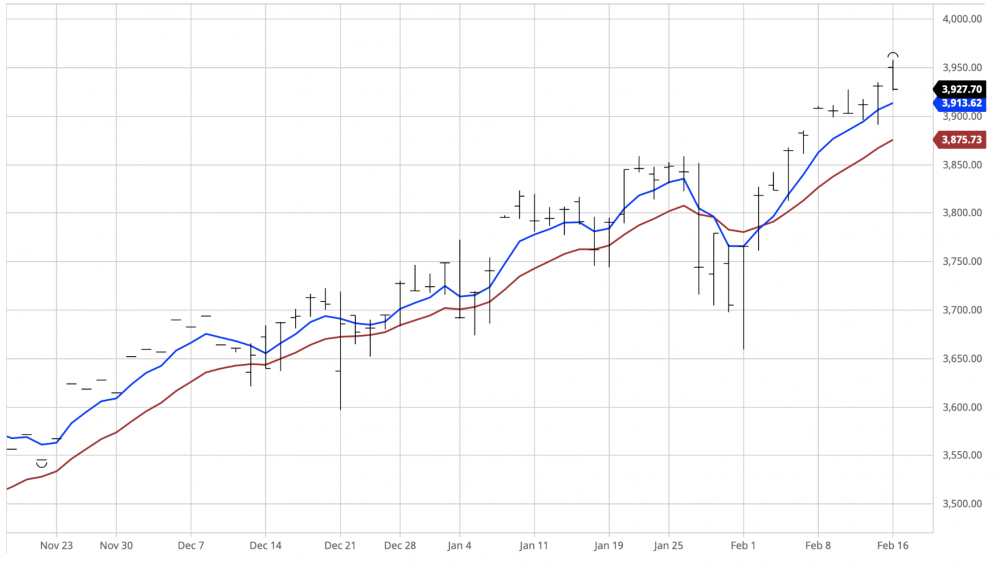
The 5-day/13-day Exponential Moving Average is a positive gauge to identify broader market sentiment. As the chart indicates below, the last crossover into positive territory occurred on February 3, 2021. |
|
| | | This technical indicator suggests continued momentum into the market with stable institutional flows.
In time,
|
|
| | | | | | |
|
|




Post a Comment
Post a Comment