Look Where No One Else Is LookingBy Berna Barshay  Investing is a competitive game... Investing is a competitive game...
In the big picture, every trade has a winner and a loser. There's always someone who sold right before a stock goes up... or vice versa. For every great stock purchase you make, someone else willingly sold you those shares. The investing business has only gotten more competitive in the nearly 30 years that I've been working in the markets. Information advantages have been whittled away through regulation and the near-instant dissemination of information on the Internet. It's funny to think about now, but when I was a rookie analyst covering European stocks in the 1990s, it was a big advantage to be able to obtain an overnight mailed copy of an annual report a day or two before my peers. In a similarly dated memory, I remember the look of shock that I gave my elders at Goldman Sachs (GS) right out of college when they showed me the giant rows of fax machines that received press releases from companies and news of analyst upgrades and downgrades early in the mornings, which allowed for more nimble trading on the market open. Not only does information move around instantly these days, but regular investors are also fighting against computer-driven algorithms that could be completing hundreds of calculations in the time it takes you to read this sentence. Lots of professional money managers pride themselves on leaving no stone unturned when doing research... This is a good strategy, but it's a hard one to win with when you're competing against Wall Street shops with deep pockets to pay industry consultants and buy expensive market and industry data. I've made money at times in my career when I was truly confident that I knew as much as anybody looking at a company, but those times were few and far between. And given the extreme level of competition with well-resourced players, the times that I really thought I figured out something that no one else had inevitably occurred when I was basically fishing in a pond by myself. At one extreme, think of a stock like e-commerce giant Amazon (AMZN)... I can have an intelligent, well-reasoned opinion about the company. But I would be hard-pressed to come up with an insight no one else has thought of yet. Amazon has 55 sell-side analysts closely following its stock... nearly every money management firm looks at it... and your Uber driver and barber probably even have an opinion on it. It's going to be hard for me to know something about Amazon that nobody else knows. That doesn't mean I can't make money on it... It will just be harder to gain an advantage that nobody else has. What's much easier is finding a gem that's under-covered and overlooked by Wall Street. A stock that has little to no sell-side coverage. One that most people at a cocktail party haven't heard of. Or maybe a company you didn't even realize was publicly traded. 'Under-the-radar stocks' offer great opportunities for outsized returns... These unknown gems may trade at cheap valuations because they haven't caught the interest of big institutions. Under-the-radar stocks usually have smaller market caps, so it just isn't worth the time and resources for a massive hedge fund to dig into the story. The liquidity and size isn't there to move the needle for an investor deploying billions of dollars of capital. Wall Street analysts tend to ignore these companies as well, since they have little financial incentive to get involved. A stock might be ignored for a number of reasons, but that doesn't preclude it from being a great investment.
| Recommended Links: | |  REPORT: Women are better investors than men Studies from Fidelity, the Warwick Business School, and Cal-Berkeley found that women make better investors than their male counterparts. That's why we went out and hired one of Wall Street's prized female investors, Berna Barshay. On Thursday, June 10, at 12 p.m. Eastern time, Berna will join us in a historic online event where she'll discuss three stocks that she believes every investor should buy immediately. Join us for this presentation to learn how you could supercharge your portfolio and accelerate your wealth. Register today by clicking here. | |
|
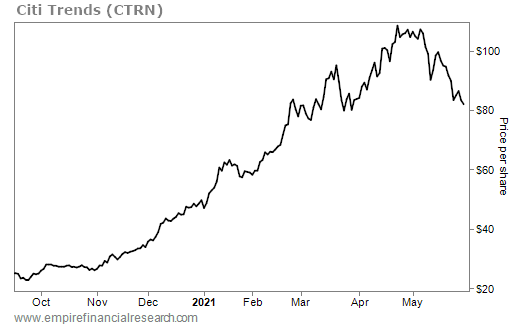
One of the first times I made big money with an under-the-radar stock was with storied retailer Loehmann's... The company was legendary as one of the first off-price retailers. Long before Ross Stores (ROST) or TJX Companies' (TJX) TJ Maxx, Loehmann's was offering premium brands at deep discounts by purchasing end-of-season leftover goods from department stores or designers. Loehmann's started as a single store in Brooklyn in 1921 and grew to a 100-store chain by 1999. But then, it fell on tough times. Having overexpanded, the company got in a cash crunch and filed for Chapter 11 bankruptcy. When it was emerging from bankruptcy in late 2000, it was a leaner, meaner company with fewer, more productive stores. Having been a Loehmann's shopper since I was young, I was surprised to see it come to the public markets post-bankruptcy. Nearly two years after it exited bankruptcy, the company's stock was largely unknown and traded at a low price-to-earnings ("P/E") multiple, despite having good business momentum. No Wall Street bank analysts on the sell-side were following the shares. I bought the stock in my fund in mid-2002 around $7.50 per share... and after two years, there were still no sell-side analysts following the stock. But that didn't stop Loehmann's from getting taken private by a Middle East-based private equity firm for almost $23 per share... Sadly for us bargain-seekers, Loehmann's didn't make it to its centennial, and instead ended up in liquidation bankruptcy in late 2013... but long after I had already tripled my money. Loehmann's was a long time ago, but under-covered gems can still be found in today's competitive market... Last September, we were looking to put together a special "Biden Investment Blueprint" portfolio for our Empire Investment Report newsletter consisting of names that would benefit in the event that the Democrats won the White House and the Senate. My mind immediately went to Citi Trends (CTRN), a small-cap retailer catering to low-income customers who would see big increases in their purchasing power if the minimum wage moved higher, per the stated Democratic agenda. Citi Trends – like TJ Maxx and Loehmann's – is an off-price retailer. It offers brands for less by purchasing overstocks and misfires, and supplementing those inventory buys with unbranded product to offer a comprehensive selection in its categories of women's, men's, and children's apparel, footwear, and accessories. The company has also been expanding its merchandise of late to include more home goods, toys, and beauty in an effort to capture more share of its customers' wallets. What differentiates Citi Trends from TJ Maxx and Ross isn't just the size of its stores, which are much smaller, but also where they're located. While you might find a TJ Maxx in a strip shopping center in an upscale suburb sitting next to a Target (TGT) and a supermarket, perhaps near a Chipotle (CMG) or Petco (WOOF) as well... you'll find a Citi Trends in a much less ritzy center – typically sitting with a dollar store, a sporting goods shop, a beauty supply outlet, and a McDonald's (MCD). Citi Trends goes into lower-income neighborhoods populated by people of color. It invests in neighborhoods that TJ Maxx and Ross Stores usually don't. The stores, with their smaller size, have more of a neighborhood, mom-and-pop feel... even though Citi Trends is a chain. I've always been intrigued with Citi Trends... Because of its sound strategy in a well-carved out niche with limited competition, I thought the chain had unexploited potential. Just like it's easier to pick a truly undervalued stock when you look where everyone else isn't, it's much easier to make sales as a retailer to an underserved customer than an overserved one. Additionally, Citi Trends has always maintained a cash-rich, debt-free balance sheet, which has helped it persevere through tough times. The problem with Citi Trends over the years was that its execution had been uneven... and so had the stock performance. For many years, I would meet with the company's CEO or CFO at a January conference, and I would inevitably be one of only three or four people who showed up for the session. Meanwhile, higher-profile companies at the same conference attracted 20 or more analysts. I attributed the uneven execution at Citi Trends to sleepy and so-so management. But after my annual meeting with the company in January 2020, I thought that might be about to change... In early 2020, Citi Trends announced a new CEO named David Makuen who had previously been an executive vice president of marketing and strategy at Five Below (FIVE) – a well-run and high-performing niche dollar-store chain. When I met Makuen, he hadn't even started his job yet, but he discussed big plans for taking advantage of the low-hanging fruit that I had long suspected existed at Citi Trends. A thematic fit for our "Biden Investment Blueprint" group, I had high confidence that even if Biden lost the election, Citi Trends would be a winner under new, energized leadership. And CTRN shares were cheap... trading at a P/E ratio just over 10 times, based on my estimate of calendar 2020 earnings. And I had to go with my estimate... since no sell-side analysts were covering the stock (and therefore I couldn't consult with any "consensus estimates"). Since adding CTRN shares to the Empire Investment Report portfolio in mid-September, they're up more than 230% – making the stock the highest-return pick in Empire Financial Research history... Citi Trends has been one of my biggest winners ever, but it was also one of the easiest trades I ever made... It was obvious. But it didn't take two decades on Wall Street to get this trade right. You just needed to be looking in the right place – something very few people were doing last fall. Of course, now that the stock has more than tripled, Citi Trends finally got its first sell-side research initiation from Wall Street. There's comfort in investing in what's obviously popular... but some of the easiest money can be made by going where the crowd isn't. And right now, I've found a 'hidden' corner of the market could earn you gains of 300%... 500%... or even 1,000% over the long run. In Empire Financial Research's first-ever Wealth Accelerator event, I'm joining my colleague Whitney Tilson on Thursday, June 10, at 12 p.m. Eastern time to explain the whole story. Not only will you learn how this little-known opportunity could supercharge your portfolio... But you'll also learn how you could begin collecting a long string of triple-digit gains, starting with less capital than you might think. The event is completely free to attend, but you must reserve a space in advance. Save your spot right here. Regards, Berna Barshay
June 5, 2021 If someone forwarded you this e-mail and you would like to be added to my e-mail list to receive e-mails like this every weekday, simply sign up here. |
| 




Post a Comment
Post a Comment