The IPO Market Is on Fire... But Returns From New Issues Are NotBy Berna Barshay  Late last year, I wrote about the 'red-hot IPO market'... Late last year, I wrote about the 'red-hot IPO market'...
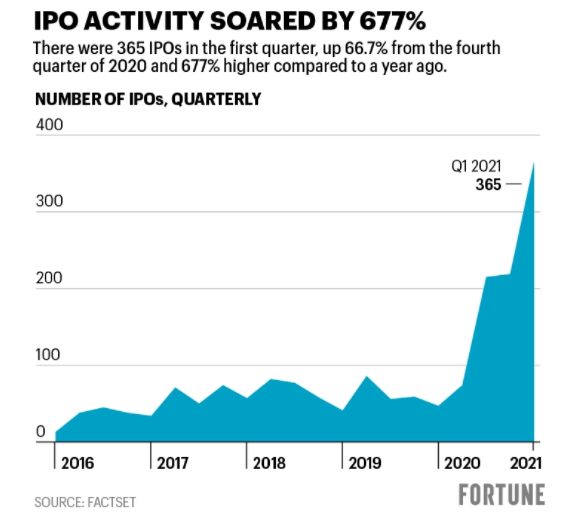
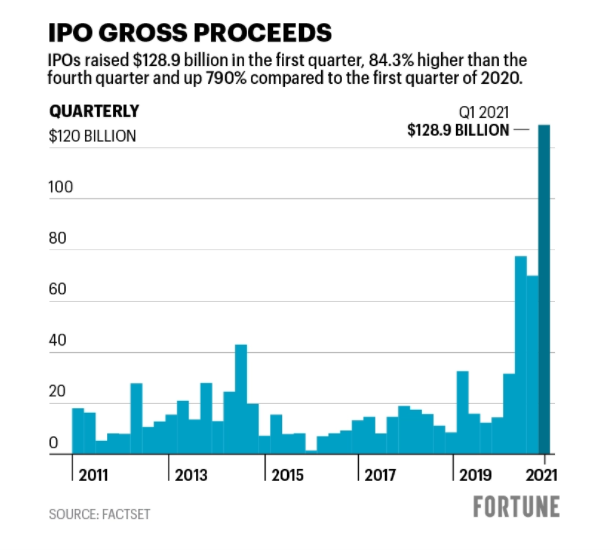
But it turns out things were only just getting started back then. According to market data firm FactSet, there were 494 initial public offerings ("IPOs") last year. These collectively raised $174 billion, which was a 150% increase over the funds raised in IPOs during 2019. Part of what drove the 2020 IPO boom was a ton of new special purpose acquisition companies ("SPACs"), the "blank check" companies that raise money and go out in search of a deal. Last year, according to FactSet, there were 247 SPAC IPOs, more than 80% of which happened in the second half of the year. Together, they made up half of all 2020 IPOs. The first part of 2021 was a banner time for SPAC issuance as well, with over 300 new SPACs raising over $100 billion. This SPAC boom is part of what drove the IPO market to even greater heights in 2021, with the first quarter seeing a whopping 365 IPOs... This is more IPOs than some full years saw historically. The number of IPOs soared 677% year over year in the first quarter... Source: Fortune The SPAC market has had a pullback, with the IPOX SPAC Index down 11% year to date. This has recently chilled the pace of new SPACs coming to the market... but the traditional IPO market has soldiered on, thanks to low interest rates, plenty of liquidity, a stock market sitting near all-time highs, and high investor appetite for new issues. If you exclude SPACs and closed-end funds from the data, the IPO market just keeps getting hotter... According to data from Renaissance Capital – which excludes SPACs, direct listings, closed-end funds, and companies with a market cap of less than $50 million – the number of companies that went public was up 15% in the second quarter of 2021 compared to the first quarter. In terms of the amount of funds raised, the second quarter bested the first quarter by about 4%. This chart only goes through the first quarter, but you can see how massive IPO proceeds this year are in the historical context... Source: Fortune Unsurprisingly, the list of the largest 2021 IPOs is dominated by tech. The biggest IPOs so far this year have included South Korean e-commerce company Coupang (CPNG), DiDi Global (DIDI) – the "Chinese Uber" – online dating app Bumble (BMBL), solar tech equipment company Shoals Technologies (SHLS), and mobile game maker Playtika (PLTK).
| Recommended Links: | |
 Jeff Brown's shocking revelation Jeff Brown just uncovered an obscure stock market "glitch" that detects massive stock moves weeks in advance. Financial elites exploit this $238 billion worth of "glitch" daily... But they want to keep you in the dark about it. That's why on Wednesday, July 28, Jeff is going public with this information for the first time. Click here for more details. | |
|
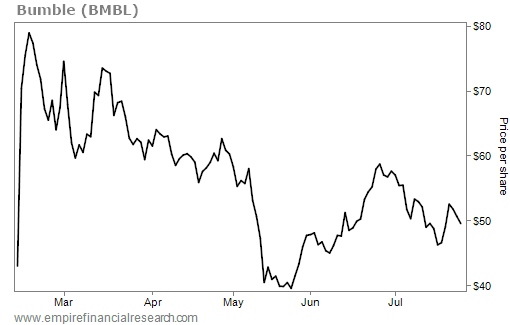
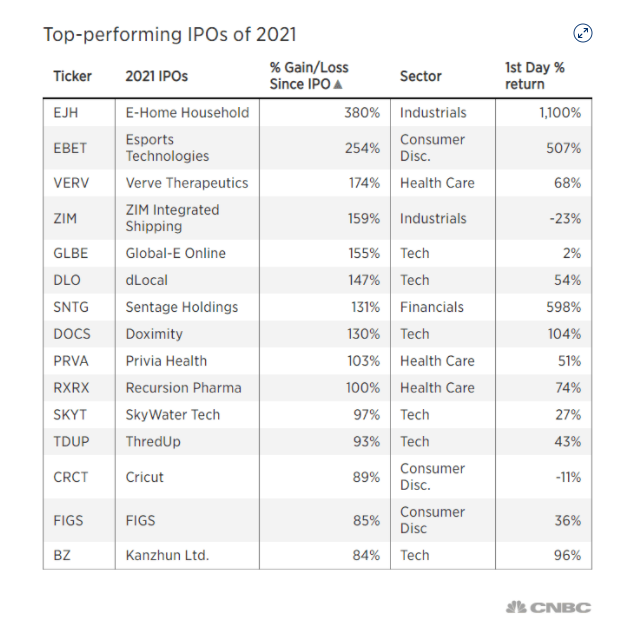
But looking at the performance of these high-profile IPOs since their debuts is less than inspiring... While three of these five IPOs are up since they came public, the returns on them aren't anything to get excited about. Since its debut on March 10, CPNG shares are up 6%... but the S&P 500 Index is up 12%. SHLS shares are also up 6% since the January 26 IPO... but you would have done better with the S&P 500, which is up 14%. BMBL shares have performed the best, up 13% since going public on February 10... They have eked out the tiniest bit of outperformance, barely besting the S&P 500, which is up 12% over the same time frame. But these returns were calculated assuming you could get in at the IPO price... which is something typically only institutional investors and the highest net worth of Wall Street's retail clients can do. If you bought these companies at the closing price of their first day of trading, you would have done much worse... Bumble soared 64% on its first day of trading. Since then, it's down 31%. Coupang was up 41% on its first day, and since then it has fallen 25%. Shoals was up 24% on its market debut and is since down 15%. Taking a look at the chart of the best of the biggest IPOs, Bumble, it's pretty clear you would need to have traded it perfectly – or gotten shares on the IPO – to be in the black today... Even with the winning IPOs, it would have been pretty tough for a retail investor to make money... But it was even worse with the "busted" IPOs, which is what it's called when an IPO trades below its deal price. The Playtika IPO busted, with shares trading hands today around $22. That's $5 below its IPO price of $27, despite the stock going up 17% on its first day of trading. This leaves us to review DiDi, which is this year's posterchild for a busted IPO... The company went public at $14 per share on Tuesday, June 29. By the next Tuesday, July 6, it was a busted IPO. DIDI shares fell 20% that Tuesday after China's Internet regulator opened a security review and ordered the DiDi app removed from stores over the July 4 weekend. Chinese regulators had asked DiDi in the months before its IPO to delay it, as issues started to crop up over its huge amount of user data. China's antitrust authority had also told DiDi to stop hiking prices arbitrarily. DIDI shares sit around $8 today, down roughly 40% from their IPO price. Yesterday, the 25-day quiet period for banks involved in the DiDi IPO expired. During this quiet period, analysts who work for the underwriting banks are precluded from issuing initiation reports or recommendations on a newly public stock. Usually, after the 25-day mark passes, you see a flood of initiation reports on a new IPO... But Monday came and went, and it has been crickets from DiDi's lead underwriters – Goldman Sachs (GS), JPMorgan Chase (JPM), and Morgan Stanley (MS). It has been silence as well from others in the underwriting group, such as Barclays (BARC.L), Bank of America (BAC), and Citigroup (C). DiDi is clearly a special case, as its conflict with the Chinese government is front-page news and has triggered much general trepidation over shares in Chinese companies that trade in the U.S. Chinese e-commerce giant and market bellwether Alibaba (BABA) is down 43% from its October high. Nervousness about interventionist Chinese government actions predated the DiDi debacle, but it's worth noting that BABA shares are down 17% since the problems at DiDi surfaced. Even putting DiDi aside, if you had bought the other four big IPOs at their IPO prices and equal-weighted them, you would only be up 1.5% now... which is big underperformance versus the S&P 500. And if you bought Coupang, Bumble, Shoals, and Playtika at the closing price their first day of trading, you would have done even worse. Equal-weighted, they're collectively down 25% from their first-day debuts. That isn't good under any circumstances, but it's particularly awful when you consider the S&P 500 is up 17% year to date. This got me wondering if it's just the very largest IPOs that have been performing poorly... To figure this out, I turned to Kuppy's Event-Driven Monitor, a product that tracks different kinds of situations, including IPOs, SPACs, spinoffs, mergers, and other corporate actions. According to the Monitor, 42% of 2021's IPOs have busted. It looks like the bust rates were higher in the first few months of the year. But over the past three months, the bust rate has still been about 35% for new IPOs. I don't have historical data on this... but it seems high to me. Whether you look at the very largest IPOs or the IPO universe in aggregate, it doesn't seem like the IPO market has been a particularly fruitful place to go hunting for returns this year. There have of course been exceptions, such as microcap tech company Esports Technologies (EBET)... The stock is up 265% since its April IPO, which was led by a bank I have never even heard of called Boustead Securities. Tiny machine learning company Alfi (ALF) has also been a big IPO winner, up 148%, but it went public with a market cap of only about $50 million. These two IPOs weren't on a lot of radar screens. Some higher-profile IPOs have of course also done well, like e-commerce software company Global-e Online (GLBE) which is up 145% from its May IPO. Online thrift store thredUP (TDUP) has risen 75% since going public in March... and scrubs company FIGS (FIGS), which a reader wrote in about, has soared 65% since its May IPO. You can see the list of the top-performing IPOs of 2021 so far here... Source: CNBC Regular Empire Financial Daily readers might recall the April 5 essay in which I explained how the success of tech giant Amazon (AMZN) trained investors to be overly tolerant of perpetual red ink. I call companies that can grow the topline but can't turn a profit examples of "profitless prosperity"... Event Monitor author Harris "Kuppy" Kupperman calls them the "Ponzi Sector." A lot of the companies going public now fit into this "profitless prosperity"/"Ponzi sector." It's clear we're in a bit of an IPO Bubble, but when it ends... who knows? I'll refer back to Kuppy's conclusion in his excellent "Ponzis Go Boom!!!" blog post... Bubbles are highly unstable – if they're not inflating, they're usually bursting – there isn't really a middle option. Right now, we are clearly still inflating. But the fact that more than one-third of IPOs are busting is a red flag. So is the fact that two of the five largest IPOs this year busted, especially since one of them – DiDi – is a flat-out disaster. The bar has been lowered for what it takes to pull of an IPO these days. That doesn't mean there won't be some amazing companies going public... but when there are so many IPOs, finding the good ones increasingly has become a needle-in-the-haystack exercise. Companies are coming out of the gate too expensive, and the good ones are going up too much the first day. As examples, I'm a fan of business intelligence software company Qualtrics (XM) and dating app Bumble. But it has been tricky to make money in either stock, because they were expensive when they went public, went up too much the first day, and then went down a lot. If you didn't get shares on the IPO, it's been tough – even with these quality businesses. The IPO bubble may take time to burst, but the takeaway here is that investing in IPOs is already treacherous, even if the bubble continues. Price sensitivity is key to making money in IPOs, even when you have a great business. In the mailbag, readers react to last week's essay on the billionaire space race... Most of the letters were defending the billionaires, arguing they can spend their money however they like and that I need to think bigger. There has been an interesting gender dichotomy (with exceptions, as always) in the feedback, with women more sensitive to issues of ego and waste. Have you found it as tricky as I think it is to make money in IPOs this year, assuming you didn't get IPO shares? Do you think we're in an IPO bubble? What upcoming IPOs are you most looking forward to? Anyone care to venture into the treacherous waters of guessing why men and women tend to look at the billionaire space race with different lenses? Share your thoughts in an e-mail to feedback@empirefinancialresearch.com. "Berna, why such criticism of Bezos, Branson, and Musk for their space ventures when it's their money (or their investor's) that finances the ventures? As long as their money is made honestly – and as a reward for hard work, innovation, and excellence – it's fine with me. Frankly, I'm glad to see such ventures coming from the private sector – government throws tons of money at projects which languish or never see the light of day. All three of these guys have succeeded in getting their ventures to space, and in a relatively short time no less. "What's more, I get to participate somewhat by buying a computer from Amazon (AMZN), a car from Tesla (TSLA), or taking a flight on Virgin Air... profits from my purchases enable these space efforts. "Also, I think you're short-sighted in trying to analyze these ventures based on their near-term tourism goals. Sure, there's some ego involved, but I think all three of these innovators are looking at ultimately harvesting space. By that I mean they will develop craft that will encounter near-earth asteroids, mine them, and return untold riches in rare metals to earth. With so many of these metals currently controlled by countries like China (no friend of ours), these 'elemental' ventures will become the real fruits of today's ego trips. I think we'll look back with gratitude!" – Biff B. "HA! Why not celebrate a person who rose above the crowd and fulfilled an impossible goal for a private citizen? He went from normal person to spectacular amazing entrepreneur creating a company and email system that saved our asses for getting stuff during the Covid-19 disaster. He had a goal and accomplished his wildest dreams and, in the meantime, helped all of us to live a better life. How cool is that." – Daniel M. "Hi Berna, I think that the billionaire space race is mostly about egos with some humanity thrown in. I don't like the hefty price tag, but I understand that going into space is expensive. I think some of that money should go towards cleanup, atmospheric and otherwise, if launches become regular. If seeing the Earth from space is finally what makes people realize how beautiful and fragile our precious planet is, then I'm all for it. I would go in a heartbeat if someone else paid or if I could afford it. I've wanted to be an astronaut since I was little, but my eyesight prevented me from qualifying. And yes, the tax code should be rewritten so everyone pays a minimum tax, people and corporations alike. We all use the U.S. infrastructure and should all help pay for it. "I enjoy your articles and the opportunity to interact." – Kristine B. Regards, Berna Barshay
July 27, 2021 If someone forwarded you this e-mail and you would like to be added to my e-mail list to receive e-mails like this every weekday, simply sign up here. |
| 




Post a Comment
Post a Comment