The Update Issue: The Great Office Return Is in Jeopardy, a 'Totally 2021' IPOBy Berna Barshay  Last week, tech giant Apple (AAPL) made headlines when it delayed the return of its workers to the corporate office... Last week, tech giant Apple (AAPL) made headlines when it delayed the return of its workers to the corporate office...
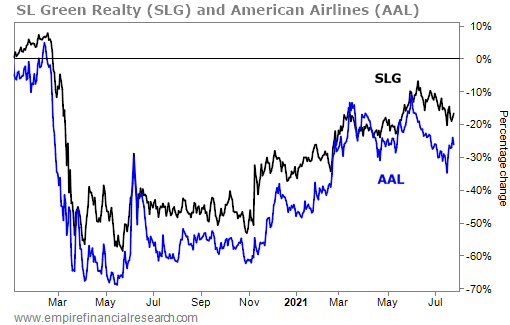
Apple had planned to bring employees back to the office three days per week beginning in September, but it's backing off that target now. It currently looks like workers will be heading back to Apple's Cupertino, California headquarters in October, at the earliest. The reason for the delay? The emergence of the COVID-19 Delta variant, along with other nascent virus variants popping up worldwide. Variants have given Apple CEO Tim Cook a good excuse for postponing a return-to-work plan that has proven unpopular with many of his employees. Maybe he can use the extra time to better sell his pitch that employees come in on Mondays, Tuesdays, and Thursdays. Apple's three-day in-office mandate compares very unfavorably to what some of the company's Big Tech peers are offering to employees, even considering the concession Apple offered to employees of being able to work fully remote for up to two weeks per year. Across the valley in Menlo Park, social media giant Facebook (FB) has told employees they can work from home full-time permanently if their job can be done remotely. Meanwhile, software titan Microsoft (MSFT) has told workers they can work from home half the time – also more generous than the 40% that Apple is offering up. Other tech leaders like social media firm Twitter (TWTR) and music streaming service Spotify (SPOT) have, like Facebook, offered a permanent, full-time work-from-home option. Even before the emergence of these new variants, Apple employees were pushing back on the three-day-per-week plan. Last month, tech site The Verge obtained a letter circulating internally among Apple employees... We would like to take the opportunity to communicate a growing concern among our colleagues that Apple's remote/location-flexible work policy, and the communication around it, have already forced some of our colleagues to quit. Without the inclusivity that flexibility brings, many of us feel we have to choose between either a combination of our families, our well-being, and being empowered to do our best work, or being a part of Apple. Pre-pandemic, the opportunity to work two days per week at home forever might have seemed like abundant flexibility and a real perk. Unfortunately for Apple and many other corporate employers operating in sectors where competition for talent is intense, the bar on what constitutes flexibility and perks has been substantially raised. Internal unrest like that at Apple, as the company tries to turn back the clock and return at least partly to pre-pandemic in-person work expectations, is something many employers will be encountering... especially ones that offer jobs less coveted, prestigious, and high-paying than the ones at Apple. While the delay conveniently allows Apple to kick the can on a showdown with employees, the primary motivator for the delay is rising COVID-19 cases and viral variants... Most businesses that were not back already had been gearing up for a great return to the office around Labor Day. That is now at risk. Referring to the 180% rise in COVID-19 cases over the past two weeks and the 30% rise in COVID-19 deaths over the same period, the New York Times explained earlier this week... It all adds up to a difficult calculation for America's business leaders, who hoped the country would already be fully on a path to normalcy, with employees getting back to offices. Instead, individual companies are now being forced to make tough decisions that they had hoped could be avoided, such as whether to reverse reopening plans or institute vaccine mandates for employees. We've seen an increasing number of companies requiring employees to get vaccinated if they want to come back to the office, including investment bank Morgan Stanley (MS), which is requiring vaccination for New York City and Westchester employees coming to the office. Twitter isn't making anyone come back to its San Francisco offices... but those who want to will also have to get a vaccine. We're also seeing vaccinations become mandatory at many health-care services companies. But requiring vaccinations is a politically fraught decision and can cause legal headaches. The less controversial approach to keeping workers safe is to just postpone the return of full-capacity in-office work, which we've seen not just at Apple but also at other employers such as talent agency Endeavor (EDR). Meanwhile, other companies have been holding the line on their post-Labor Day return... but are suddenly qualifying language in a way that indicates plans are currently being reevaluated. Such is the case at companies like bank Wells Fargo (WFC) and job site Indeed. Other corporations are powering forward with reopening, such as HP (HPE), but only after surveying workers and finding them 94% vaccinated. Of course, most of the companies shuffling their feet on reopening are located in California and New York... Reports of a reopening walk back seem more muted in places like Texas and Florida. Eventually, COVID-19 concerns will dissipate for corporate HR departments... As for the variants and their potential effect on the economy, I'm not too worried about it. But I do think the longer in-office work and business travel are postponed, the less likely they will be to ever return to their pre-pandemic levels. This leaves me cautious on highly leveraged owners of urban office towers as well as debt-laden airlines that skew heavily to business travel, with SL Green Realty (SLG) and American Airlines (AAL), respectively, being prime examples. Both companies have rebounded quite a bit off their lows, but they haven't fully recovered to early 2020, pre-pandemic trading levels... The longer we spend not going back to normal, the harder it will be for these companies to return to full pre-pandemic earnings power.
| Recommended Links: | |
 This information is time-sensitive Jeff Brown just uncovered shocking details about an obscure stock market anomaly... a Nasdaq "glitch" that sends certain stocks up as high as 891%... 1,760%... even 2,125%. He says the "glitch" is set to trigger again soon. Get the details here. | |
|
Following up on yesterday's essay on the hot initial public offering ('IPO') market, I was eagerly awaiting shares of foreign language education app Duolingo (DUOL) to start trading today... DUOL shares finally started trading around lunchtime, and currently sit roughly 30% above the IPO price of $102. There's a lot to like about Duolingo. It operates in a large and growing market – there are 1.8 billion aspiring language-learners in the world. The company's CEO and co-founder Luis Von Ahn is a proven serial entrepreneur-engineer, who previously found success creating the omnipresent reCAPTCHA e-commerce security feature. Duolingo also has a robust 40 million monthly average users ("MAU"), sports healthy 70%-plus gross margins, and has doubled bookings in each of the past three years. Beyond the financials, the product is great. I, like many people, turned to the Duolingo app during the pandemic as a productive time-filler. Once upon a time, back in my Comparative Literature student days, I was fluent in French and spoke passable Spanish. These skills have degraded over the years, and Duolingo seemed like the perfect way to revive them. The app does a great job gamifying the learning process... with competitions, badges, and streaks to be earned. It's no surprise that the app has been downloaded 500 million times, and it's impressive that Duolingo has only spent around $40 million in marketing over a 10-year period to acquire these customers. Word-of-mouth is strong for growing this app's users – another favorable piece of the business model. Great product, great potential future margins, big total addressable market ("TAM"), impressive management... what's not to like? Today's IPOs are generally expensive. Duolingo was priced at a very aggressive enterprise value to revenues ("EV/revenues") ratio of 16 times. With today's price jump, DUOL shares change hands at around 22 times EV/revenues. Even for a super business... that's a lot. The price jump today also makes me wary. As I wrote about yesterday, not only have about 42% of 2021 IPOs busted, nearly all of them that have these big first-day jumps are giving a lot of that first-day move back later. There's no need to chase pricey IPOs... even if you like the business. In Duolingo's case, I'm especially disinclined to chase the move, as the reopening of the economy almost guarantees that we will see a decelerating growth rate at the company in the coming quarters. An EV/revenue ratio of 22 times is too much to pay for slowing growth. I've got my eye on Duolingo's stock. But given how the class of 2021 IPOs have traded so far, I'll be waiting until DUOL shares are más barato (cheaper)! In the mailbag, a reader offers thoughts on the hot topic of inflation... Have you returned to the office or are you experiencing a delay with that? Do you want to continue to work at home? And are there any Duolingo users out there? If you've used the app, I would love to hear about your experience with it, how effective it was, and how long you stuck with it. Share your thoughts in an e-mail to feedback@empirefinancialresearch.com. "Berna – Thank you for covering this topic! I wrote in the other day with this request and was grateful you covered it due to the latest inflation figures. "I think the first big question is what does the Fed define as 'transitory'? Second, while in the very long-term things will be deflationary due to demographics, tech advances, our incredible debt levels, etc.... I am not convinced all of these price increases will all subside to pre-pandemic levels anytime soon. Wage inflation is not something you can bring back down, and in general, when companies increase prices on their products, they don't usually bring those back down either. "The only thing that could bring in deflation right away would be if we had another major market crash like last March. "Also, the supply shortages don't look like they will resolve in just a few months. Everyone is focusing on lumber prices coming back down but they are still much higher than pre-pandemic. Finally, how valuable is core CPI [Consumer Price Index] to us regular people when it either doesn't represent or underrepresents the most important things impacting us: energy, food, education, and healthcare? "While I understand some things like tech and electronics are very deflationary – no one is buying a new TV or computer every week or even every year! And I am not completely convinced all tech replacements are much cheaper – e.g., replacing cable TV with the panoply of subscriptions you might need to piece together. "We are in unchartered territory here as most of us have never lived through an inflationary period in the U.S... at least not as adults. I would value your opinion on what impact more "sustained inflation may have on the markets, the economy, and most importantly strategies for protecting our purchasing power. "On the topic of whether some amount of inflation is good or not because it increases wages – no clue! 🙂 "On Goldman Sachs (GS) – I think they should pay more. "GenZs are a VERY different generation. They have a significantly lower tolerance for BS and "abuse" than you (Berna) or I did. I worked for McKinsey many years ago, and while I did not do pay comparisons, one major reason for me going there was the brand and prestige. I really don't think GenZs care as much about that. If you are a smart, motivated young person, is it really going to make that much of a difference in the long run to work at Goldman v. JPMorgan Chase (JPM) or Bank of America (BAC)?? "AND with all of this inflation and things getting so much more expensive (e.g., rents!) Goldman is crazy if they think reputation alone will get them the best candidates. My niece is an example... she is first year at GS. She hates it and is actively planning her exit. They will pay more in the long run if they don't match pay and more importantly figure out what truly motivates this younger generation. The Boomer leadership at Goldman is most certainly outdated in their thinking. "Thank you again for your insightful and thoughtful articles – I make time to read them on most days despite the information deluge in my inbox!" – Kelly Berna comment: Kelly, thanks for writing in. I agree with many of your points, particularly the one about CPI. For a long time – primarily because of soaring housing, education, and health care costs – inflation has felt a lot higher than the reported CPI. As for inflation, it's generally not terrible for the markets as equities are inflationary assets that go up with prices. But if the U.S. Federal Reserve raises rates in response to inflation... that is bad for the markets. Thinking about inflation's impact on purchasing power, it depends on whether or not wages move in lockstep with overall inflation or not. For decades, wages have not kept up... but very recently, they are leading inflation. Regards, Berna Barshay
July 28, 2021 If someone forwarded you this e-mail and you would like to be added to my e-mail list to receive e-mails like this every weekday, simply sign up here. |
| 




Post a Comment
Post a Comment