Editor’s Note: This week, we’re casting a special spotlight on Mike Carr in a mini takeover of Money & Markets Daily. Mike just unveiled his breakthrough technique for generating income today — and we made sure to get you early access to some of his insights about it right here. |
Skirt Disaster With a 90%+ Win Rate |
Money & Markets Daily,
Safety is very important to many investors. They try to buy when stocks offer a margin of safety — or they want safe dividends.
We have metrics to define such concepts.
A margin of safety might mean the stock is trading at less than 80% of its book value. There's room for its share price to grow before being perceived as "overvalued." Of course, this assumes the book value is accurate, and the company’s assets could be sold for their estimated fair value.
But we have two obvious problems with that…
The book value depends on the assumptions of management and accountants. If the management team isn’t honest, the book value is unreliable. And while accountants follow strict rules, they don’t account for changes in the market that can diminish the value of an asset.
Safe dividends are usually just a small portion of the company’s cash flow. And that assumes the company can suffer a business loss and maintain the dividend.
It ignores the reality that markets change. Any company — even a market leader — can see its business decline over time.
Of course, with proper analysis, there is only a small probability that a negative event will occur in any given year. Still, small probabilities add up to large risks over time.
 | Mike Carr is in the top 1% of analysts worldwide. And now, leveraging his decades as a computer scientist for the U.S. Government…helping to develop the first generation of artificial intelligence…
He engineered an algorithmic system… which laid out a strategy with the power to grow an account 199% over the last year.
And now he’s sharing exactly how it works.
Click here for full details. |
There's Always Risk
Let’s say there is just a 1% chance of a negative event in any given year. Over 30 years, that results in a 26% probability.
Even the best analysts can’t always see long-term risks. Thirty years ago, Ford was considered a great car company. Its share price had gained 750% in the previous 10 years and was set to deliver another 550% gain in the next five years.
But then, in 2007, analysts started to understand that Ford and other automakers were also finance companies. In the 2008 crisis, Ford lost more than 90% of its share value. A business that had survived the Great Depression and stagflation of the 1970s was almost bankrupt.
Looking ahead, I expect to see another crisis in the next 30 years. In fact, we will probably see several major global events. No one knows what they will be, or we will take action to prevent the problems from occurring.
I also understand that issues can arise at any time. But the point is that risks are smaller in the short term.
Benefit From Short-Term Strategies
Let’s look at the risk and safety of a quick three-day trade…
We can assume there is a 1% chance of a negative event on any given day. There’s a 2.97% probability of that event over three days. In other words, we have a 97% probability of success on that trade.
While cumulative risk isn’t a standard way of thinking about trades, it’s an important idea. It’s also one of the reasons I prefer short-term strategies.
In one of my premium trading services, I recommend very short-term trades that are open for just one to three days. I can model the risk on these trades for a better shot at profits — only accepting signals with at least a 90% probability of success.
I’m excited to finally be able to reveal this "Accelerated Income System" with you today. If you're looking for dividend-like payouts without having to buy and hold stocks for years, you need to see this.
You can find the full details, and learn how to get started with these low-risk trades, right here.

Michael Carr
Editor, Money & Markets Daily
 | This $10 microchip company is at the heart of the new technology experts say will mint the first trillionaire. Find out more. |

The Great Housing Mystery Explained
Higher mortgage rates should reduce home prices. That's because most people shop by payment. In other words, they determine the amount of their mortgage payment, find out how much home that buys, and then start shopping. Higher rates mean higher payments, which should lead to lower home prices as sellers are forced to meet buyers where they are.
Over the past year, mortgage rates rose, but so did home prices. Research from the Federal Housing Finance Agency (FHFA) explains what happened.
Researchers found that over the past two years, higher rates should have resulted in a 3.3% drop in prices. But homeowners refused to sell because their existing mortgages were lower than what they'd have to pay for a new home. You can see the gap between existing mortgage rates and rates on new loans in the New York Times chart below. Many couldn't afford a similarly priced home, so they chose to stay put.
The FHFA believes “this mortgage rate lock-in led to a 57% reduction in home sales with fixed-rate mortgages in 2023Q4 and prevented 1.33 million sales between 2022Q2 and 2023Q4.” This trend is getting worse, with current rates now about 3.2% above existing mortgages. This points toward higher home prices and possible buys in the homebuilding sector.
— Mike Carr, Chief Market Technician, Money & Markets
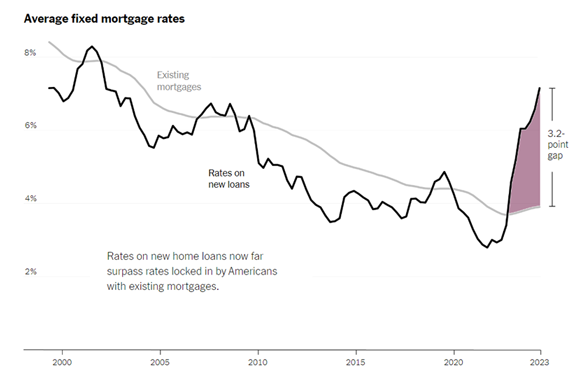
(Click here to view larger image.)
Check Out More From Money & Markets Daily:





Post a Comment
Post a Comment