What the Railroad Revolution Teaches Us About AI |
Money & Markets Daily,
AI is the next revolutionary tech — and I think most of us can agree on that.
But as investors, you and I also need to look beyond what’s obvious. We need to uncover the hidden gems in the story to find a competitive edge.
To help us discover that edge with AI we can consider how technology like railroads changed America.
Railroads helped the U.S. move away from the East Coast and provided a faster and more efficient means of transportation for people and goods. They enabled settlers to reach previously inaccessible areas, leading to the development of new towns and cities along their routes.
As people moved west, the national economy grew. Railroads revolutionized transportation and commerce — significantly reducing the time and cost of shipping goods across long distances.
As a result, this stimulated economic growth by expanding its reach beyond local areas. Farmers, manufacturers and businesses could now access larger markets and increase production and trade.
But it took more than an engine and railroad cars to do all that…
Ripple Effect of the Railroad Revolution
These railroads required a lot of steel. That led to the development of industrial centers along their routes. Cities such as Pittsburgh, Pennsylvania, and Gary, Indiana, became major industrial hubs due to their strategic locations along railroad lines and access to raw materials.
These cities attracted investment, skilled labor and entrepreneurs, fueling the rapid growth of steel production and manufacturing.
But then, getting materials to new cities required even better railroads.
The demand for more efficient and powerful locomotives spurred tech innovation in the railroad industry.
Engineers and inventors developed new technologies, including the steam locomotive, the air brake and the telegraph. These improved the speed, safety and efficiency of rail transportation.
These innovations not only benefited the railroad industry but also had ripple effects across other sectors of the economy, driving further industrialization.
Some of the best investment opportunities were in these other sectors — urbanization, commerce, finance, tourism, agriculture, communication and manufacturing, to name a few — rather than railroads.
This kind of revolutionary ripple effect on multiple industries and sectors applies to AI today.
 | Jeff Bezos, Bill Gates, and Peter Thiel are all pouring millions into a new type of technology. All as ChatGPT’s Sam Altman declares, the future of AI depends on delivering a breakthrough.
On Thursday, May 9 at 1 p.m. ET, Adam O’Dell will break down why that could trigger a 10X windfall for one small stock over the next 12 months.
Reserve your seat for the AI Power Summit for the full story. |
A Hidden Gem of the AI Revolution
We know that AI tech requires specialized chips, which benefits chipmakers and is spurring innovation in that industry.
However, future AI growth will need much more than chips. Just like railroads required much more than engines and train cars, AI will use a bigger infrastructure to meet a massive demand.
Some surprising supply constraints on AI right now have created hidden investment opportunities.
These restraints are a hidden gem of the AI story that isn’t on everyone’s radar just yet.
So if we jump in early, we could see massive profits as AI continues on an explosive trajectory to affect every part of the economy — a ripple effect that will be many times bigger than the railroad revolution.
Adam O’Dell has been diving deep into this overlooked AI story. He’s been closely studying the industries that are key to powering and expanding AI.
He’s sharing the best investment opportunity he found in this research that no one has caught on yet.
Now, you can be one of the first to learn about it. Just be sure to secure your spot here to Adam’s AI Power Summit — streaming tomorrow (May 9) at 1 p.m. ET.
Until next time,

Michael Carr
Editor, Money & Markets Daily
 | From our Partners at Banyan Hill Publishing. A little-known AI firm was founded by two of Silicon Valley's most secretive billionaires. They spent four years covertly bankrolling their project. Now, their firm could soar 2,500% in the coming years and 5,000% within a decade, as it dominates the $22.1 trillion artificial intelligence industry. (Full story…) |

ISM Points to Stagflation
The worst of all worlds for the economy is stagflation — stagnant growth with inflation. Last week's survey of manufacturers from the Institute for Supply Management (ISM) showed signs of the worst.
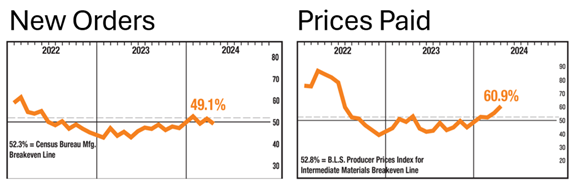
The report consists of a series of sub-indexes measuring essential steps of the manufacturing process. The ISM new orders data, shown in the chart on the right below, is at the beginning of the process. This index fell 49.1% in April. Values below 50% are consistent with contraction.
Prices Paid — an index of how much manufacturing inputs cost — jumped to 60.9%. Combining both indexes, we get an outlook that points to a manufacturing slowdown later this year. This will represent a drag on GDP while prices are rising, and that's the worst of all possible worlds for the economy.
— Mike Carr, Chief Market Technician, Money & Markets
(Click here to view larger image.)
Check Out More From Money & Markets Daily:





Post a Comment
Post a Comment