The Fed's 2 Biggest Issues for 2025 |
Money & Markets Daily,
The Federal Reserve rattled markets one last time yesterday after signaling that it may only need to trim interest rates two times in 2025.
This year, the Fed held its fund rate steady at 5.5% until September, when it issued a 50-basis-point reduction.
That was followed with another 25-basis-point cut in November to bring the fed fund rate down to 4.75%.
The Fed closed out 2024 with one last 25-basis-point trim yesterday, alongside a less dovish signal for 2025.
Markets are bouncing back after a 1,100-point crash in the Dow yesterday afternoon. But investors are watching the Fed closely…
It’s not the sexiest topic, but the Fed’s policies impact all of us.
Borrowing costs for individuals and businesses impact everything from buying a home to getting a loan to expand a company’s operations.
The Fed relies on inflation rates and job indicators to determine the direction of fund rates.
However, there is one significant factor that will be the biggest influence on where rates go in 2025.
Let me explain…
 | The economist Time Magazine called “out of step with economic reality” for predicting the U.S. economy would implode in his 2005 best-selling book Empire of Debt over two years before the Financial Crisis tore America and the global economy apart… is back to issue his next warning.
Before you invest a single dollar in the markets — or make any investment decisions — it’s critical you see this alarming video right away. |
Future Expectations May Not Be Reality
Every member of the Federal Open Market Committee — the board that determines the fed funds rate — has their assessment of future monetary policy.
Some expect higher rates in the future, while others expect lower.
And the average of these expectations says a lot.
FOMC Average Shows Lower Rates Into 2027
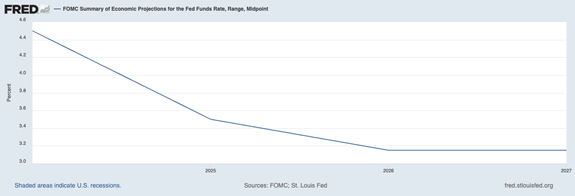
As of the most recent September updates, a majority of FOMC members see fund rates continuing to fall into 2026 before leveling out just above 3%.
Under normal circumstances, this is a valid expectation.
However, there is a new wildcard that has yet to be introduced into the mix.
The Great Tariff Debate
Once sworn in office, Donald Trump has pledged to implement sweeping tariffs on goods imported into the United States.
A tariff is basically a tax on foreign-made goods paid by the importing business to its home country’s government.
Tariffs can provide an additional source of revenue to the government and help local firms by sheltering them from foreign competition, making foreign goods more expensive, and driving citizens to buy locally.
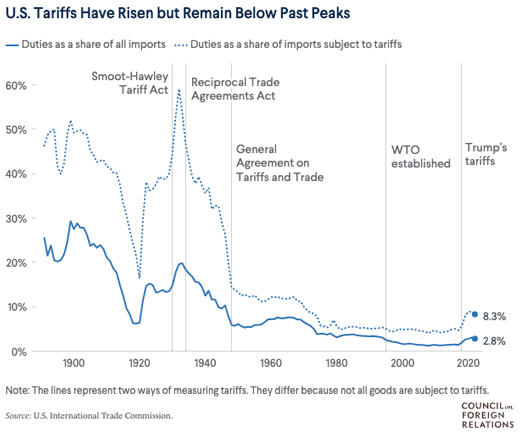
Tariffs were particularly high in the 1930s as the U.S. was in the grips of the Great Depression. Some economists suggest the nearly 900 tariffs imposed by the U.S. government in 1930 actually made the Great Depression worse.
 | A former CIA and Pentagon insider just discovered a shocking plan he’s calling Trump’s “Project Independence”…
Which could be a windfall for American patriots.
Thanks to President Trump’s plan, anyone who knows the truth NOW could potentially turn a $10K investment…
Into $265,000 or more…
By the morning of Trump’s inauguration.
Click here to discover the critical details NOW. |
However, tariffs can also make local goods more expensive, as businesses have to pass the higher costs on to consumers.
To an extent, this flies in the face of the Fed’s mandate to keep prices stable.
So, while tariffs may affect business in the U.S., will they force the Fed to take more action to combat inflation in the future?
That’s hard to say.
The Fed isn’t going to respond to relative price changes — as would likely be the case if Trump’s tariffs are implemented.
Only if price increases from tariffs lead to a sweeping increase in inflation would we likely see the Fed step in to act.
We can look back to 2018, when the Fed devised a scenario in which a 15% tariff was placed on all non-oil imports, with foreign governments responding in kind.
Under that, if the Fed raised rates because of a spike in inflation, it would have triggered a mild recession.
If the Fed did nothing, economic growth would slow, but there would be no recession.
For the Fed to reverse course and start hiking rates, more than tariffs must be in place. We would need to evaluate how strongly foreign countries are retaliating against the higher tariffs.
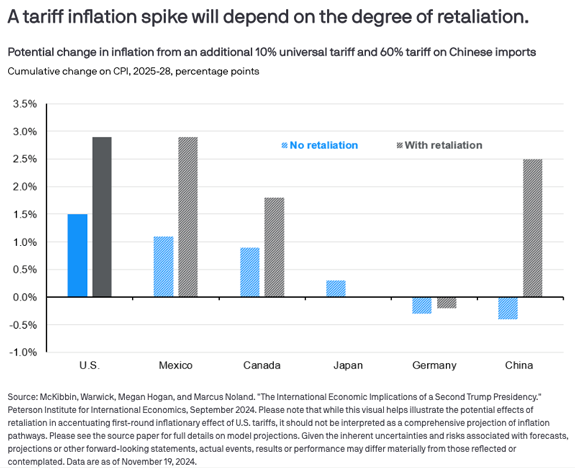
I don’t see Trump’s proposed tariffs as being inflationary on the surface, but a more prolonged trade war could be.
This is one of those times when you shouldn’t buy the hype about these tariffs.
Time will tell us a lot.
Until next time…
Safe trading,

Matt Clark, CMSA®
Chief Research Analyst, Money & Markets Daily
Check Out More From Money & Markets Daily:



Post a Comment
Post a Comment