
Ticker Reports for June 20th

IPO Momentum Returns: 3 Stocks Rising After CoreWeave's Surge
A revival of merger and acquisition activity and initial public offerings (IPOs) was firmly on the pro side of the column when Wall Street debated the merits of a second Trump presidency. The first aspect hasn’t come to pass, as the Federal Trade Commission (FTC) has retained many of the strict Biden-era M&A rules.
However, the 2025 IPO market is starting to heat up, led by artificial intelligence startup CoreWeave Inc. (NASDAQ: CRWV). CRWV shares debuted on March 28 and rose from $40 to $170 in less than three months. Most IPOs won’t achieve this type of parabolic success, but investor appetite for new issues is strengthening. Today, we’ll look at three stocks that went public this year that have the potential to disrupt incumbents in the years to come.
Investing in IPOs: Hype vs. Risk
Retail investors can access IPO shares in two ways: either by requesting an allotment in the presale or by purchasing them after they are listed on the public exchanges. The actual “offering” of the new shares occurs a few days before the public release, as underwriters gauge interest to properly price the stock. Both methods have risks and downsides to be aware of, such as:
- Lockup Period: If you purchase shares in the presale, you might be subject to certain lockup conditions regarding when you can sell shares. Typically, lockup periods last anywhere from 90 to 180 days, meaning you may need to hold an IPO stock for six months before cashing out. Naturally, lockup periods can also distort prices as the public knows when the lockup expires and anticipates insider selling by preemptively selling shares purchased on exchanges. You may need to dust off some game theory textbooks to achieve success investing in IPOs.
- The Post-IPO Pop: Highly sought IPOs often begin trading at a higher price than anticipated. For example, CoreWeave priced its IPO at $40 per share on March 27, with trading set to begin on NASDAQ the following day. The stock actually started trading at $39 on March 29, but had reached $52 by the third day of trading. If a company receives a ‘pop’ once it's listed (also known as a Listing Gain), that’s usually a good sign that demand for shares is outpacing supply.
- Lack of Financial Data: An IPO typically won’t have lengthy data rolls on sales, margins, costs, debt, or other fundamental financial inputs, as private companies aren’t subject to the same reporting requirements as those in public stock sectors. The lack of early data creates a scenario where proper due diligence is challenging, and investors must rely on sentiment and technical data to make informed decisions.
3 IPOs Besides CoreWeave Currently Disrupting the Market
CoreWeave’s momentum has given rise to a new wave of IPOs, but investors must use caution with high-flying new stocks. Volatility cuts both ways, especially when valuations soar for companies with minimal sales history or product growth. Use tight entry and exit points when trading IPOs, and always be aware of when the lockup period ends before purchasing shares of a new issue.
Circle Group: Biggest Winner From the GENIUS Act
Lockup Period Expiry: December 2
Cryptocurrency firm Circle Internet Group Inc. (NYSE: CRCL) could be a bigger success story than CoreWeave this year, given its institutional and regulatory backing. Circle maintains the USDC stablecoin, a type of cryptocurrency pegged to a stable asset, such as the US dollar. USDC is well-positioned to benefit from the new GENIUS Act legislation, as it currently meets the compliance and transparency guidelines outlined in the bill.
In contrast, its biggest competitor, Tether, does not. CRCL shares were up more than 32% on the bill’s passage, which is in addition to the 100% pop it received on its first day of trading. Shares closed on Wednesday at $197, a surge of nearly 600% in just nine trading days. Watch out for a short-term pullback from here through, as the GENIUS Act passage is a typical ‘sell the news’ event and the Relative Strength Index (RSI) on the hourly stock chart is elevated above 80.
eToro Group: Combining Social Media and Stock Trading
Lockup Period Expiry: November 10
Online brokerage eToro Group Inc. (NASDAQ: ETOR) went public on May 14 and experienced a significant IPO pop. Underwriters priced the offering at $52 (higher than the expected range of $46 to $50), and the stock debuted at nearly $70 per share on the exchanges later that day. Shares have pulled back in recent weeks, but this could be an ideal time for a new entry.
eToro’s platform combines aspects of social media platforms with brokerage services, allowing users to emulate other traders through features like CopyTrader.
Coverage of the stock has increased rapidly, with nine of 16 analysts listing it as a Buy, and an average price target of $75.88, implying a potential upside of 19% from current levels.
Chime Bank: Disrupting the Online Banking Sector
Lockup Period Expiry: September 10 (partial), December 9 (full)
Chime Financial Inc. (NASDAQ: CHYM) describes itself as a Neobank, a disruptive category of digital-only banks with no physical branches. Chime appeals to a younger generation of consumers with its mobile-first approach and commitment to minimizing fees whenever possible (no overdraft, no monthly fees, extensive free ATM network).
In its prospectus, the company noted 23% year-over-year (YOY) user growth as of March 2025 and 32% YOY revenue growth. The IPO was priced at $27 when it debuted June 12, but opened at $43, a pop of nearly 60%. However, investors should be aware of Chime’s unique lockup rules before making a purchase.
Insiders can sell 25% of their holdings after only 90 days, followed by the remaining 75% after the traditional 180-day period.

A new rule goes live in July — and the banks are quietly cashing in
A new rule goes live in July — and the banks are quietly cashing in

These 3 Dividend Stocks Combine Strong Yields With Upside
Dividend stocks can play many roles in an investor’s portfolio. Income generation is paramount. A key benefit to owning dividend stocks is the ability to generate reliable income that can supplement income or be reinvested to deliver compound growth.
In volatile markets, dividend stocks remind investors that quality still counts. For some investors, that starts with a dividend with an attractive yield, but the real appeal is finding stocks that can grow in value, too.
The highest-quality dividend stocks combine an attractive yield with stock price growth, boosting an investor’s total return. These three high-yield dividend stocks look well-positioned to deliver a strong return, making them attractive choices for income- and growth-oriented portfolios.
This Big Oil Stock Has Room to Grow
Most energy stocks have been underperforming the market in 2025. However, the conflict in the Middle East is reminding investors that things can change quickly. As of June 18, the price of oil is over $70 a barrel and many oil stocks are looking attractive.
That points to ExxonMobil Co. (NYSE: XOM), which is one of the most profitable companies in the sector. At around 15x earnings, it’s trading above its historical average. But prior to the recent run-up in the XOM stock price, it was trading at a discount to itself.
Those earnings also help ExxonMobil generate significant free cash flow, supporting its 42-year streak of consecutive dividend increases. The company currently pays an annual dividend of $3.96 per share, yielding 3.50%, which reinforces the stability of its payout. That strong cash flow also suggests investors can expect ExxonMobil to maintain its commitment to stock buybacks.
A major driver of revenue and earnings comes from the company’s oil projects in Guyana. ExxonMobil is in arbitration with Chevron Corp. (NYSE: CVX) over the 30% stake in the project that is currently owned by Hess Corp. (NYSE: HES). However, the outcome will not impact ExxonMobil’s revenue from the project.
Analysts Are Bullish on Hasbro’s Turnaround Plans
Hasbro Inc. (NASDAQ: HAS) stock is up about 21% in 2025 and is within 10% of a high that has served as resistance in both 2023 and 2024. The third time could be the charm as Hasbro is restructuring its business.
On the cost-reduction side, Hasbro recently announced it would lay off about 3% of its workforce to offset higher tariff costs. However, the more interesting story is how the company is pivoting to focus on high-margin licensing deals. This will allow the company to unlock value in iconic brands such as Transformers and Dungeons & Dragons.
These deals will also extend to partnerships Hasbro has with brands like Marvel and Star Wars. That strategic move is also part of the company's shift away from its traditional toys and games, which ties the company’s supply chain with China.
The recent run-up in HAS stock has put it above its historical P/E average. But that’s not dampening analyst sentiment. The Hasbro analyst forecasts on MarketBeat have a consensus price target of $81.25, which is a 19.6% gain from its closing price on June 18.
The recent run-up in HAS stock has pushed it above its historical P/E average, but that hasn’t dampened analyst sentiment. Hasbro pays an annual dividend of $2.80 per share, offering a yield of 4.12%, with its most recent $0.70 payout delivered on June 4. Analysts tracked by MarketBeat have a consensus price target of $81.25, implying a 19.6% upside from the stock’s closing price on June 18.
Institutions Are Buying This Overlooked Leader in Consumer Health
Consumer staples stocks have been difficult for investors to hold in 2025. Perrigo Company plc (NYSE: PRGO) is no exception.
PRGO stock is up 2.45% in 2025 but is range-bound, with many investors trading the stock to capture its attractive dividend, which yields 4.40% and has increased for the last 23 years.
Perrigo is one of the leading suppliers of over-the-counter (OTC) medications. The company's issue is its top line, which has come in just short of expectations in the last two quarters.
The bullish case for the stock will likely come from the Federal Reserve, which continues to hold interest rates steady. That will be hardest on individuals making less than $100,000 per year. However, those consumers are more likely to look for value from store-brand alternatives, which is Perrigo’s specialty.

Fed Powell can't save America
Fed Powell can't save America

Congress's May Stock Trades: What They Know That You Don't
May brought another round of congressional stock trades, but no red flags were raised by the activity reported as of mid-June. There were no sudden volume spikes, no mass rush to the exit or flood into a new name. The biggest takeaways are that Representative Marjorie Taylor Greene (R-GA) remains one of the most active traders, making dozens of position changes throughout the month, and most of the activity was among Republicans.
The other prolific May trader is Representative Robert Bresnahan (R-PA), not a name that regularly appears in the MarketBeat rankings. His activity aligns with a significant portfolio change, as he sells names in numerous sectors and buys a comparable number of positions to offset them.
Texas Instruments: A Highly-Bought Stock in 2025
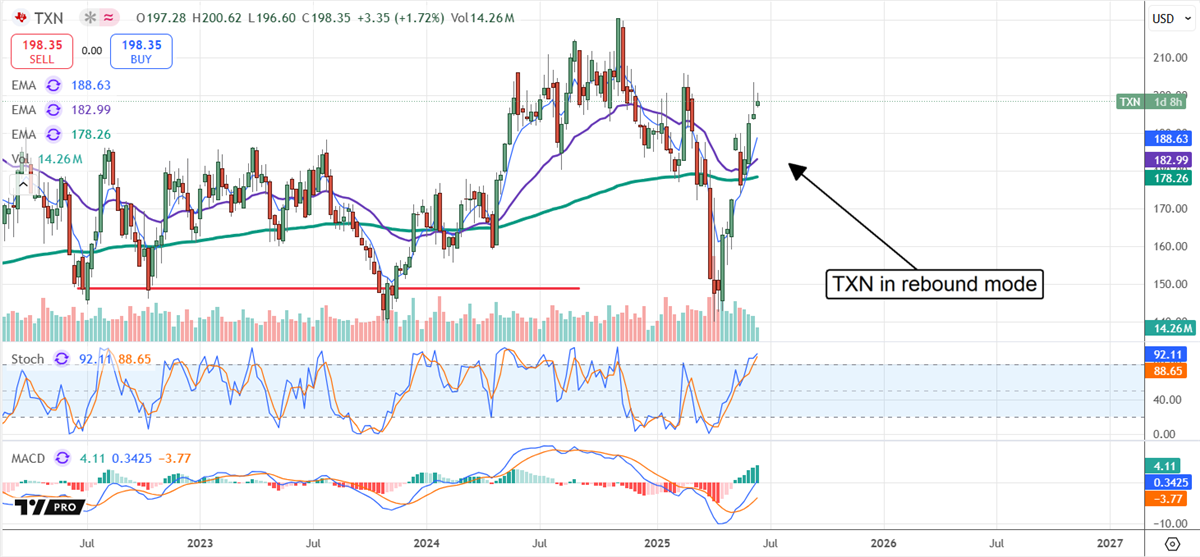
Among the interesting names on Bresnahan’s list is Texas Instruments (NASDAQ: TXN). Texas Instruments confirmed a reversal and uptrend in May, and is also among the Most Bought Stocks by Congress in Q2.
Coincidentally, Texas Instruments' uptrend is driven by its results, its position in the U.S. domestic semiconductor manufacturing landscape, and the national drive to onshore more of the U.S. semiconductor production. It is now accelerated by plans to invest $60 billion in capacity expansion.
Texas Instruments' investment will be split across seven domestic fabrication plants, creating jobs in Texas and Utah. The first of the facilities is expected to come online this year, with the others following in quick succession. The move will further solidify Texas Instruments' position as the leader in analog and embedded processing, domestically manufacturing critical semiconductors for virtually all industries.
Some other interesting moves in Bresnahan’s portfolio are repositioning within the Consumer Discretionary Sector. He sold a position in PepsiCo (NASDAQ: PEP) and added positions in Kraft Heinz (NASDAQ: KHC), Hershey (NYSE: HSY), and General Mills (NYSE: GIS).
PepsiCo has struggled with growth, but the sector has also faced challenges. All stocks are down significantly, raising questions about the moves. At face value, all stocks are trading at long-term lows and offering deep-value, high-yield entries to investors today.
Congress Buys Advanced Micro Devices, Not NVIDIA
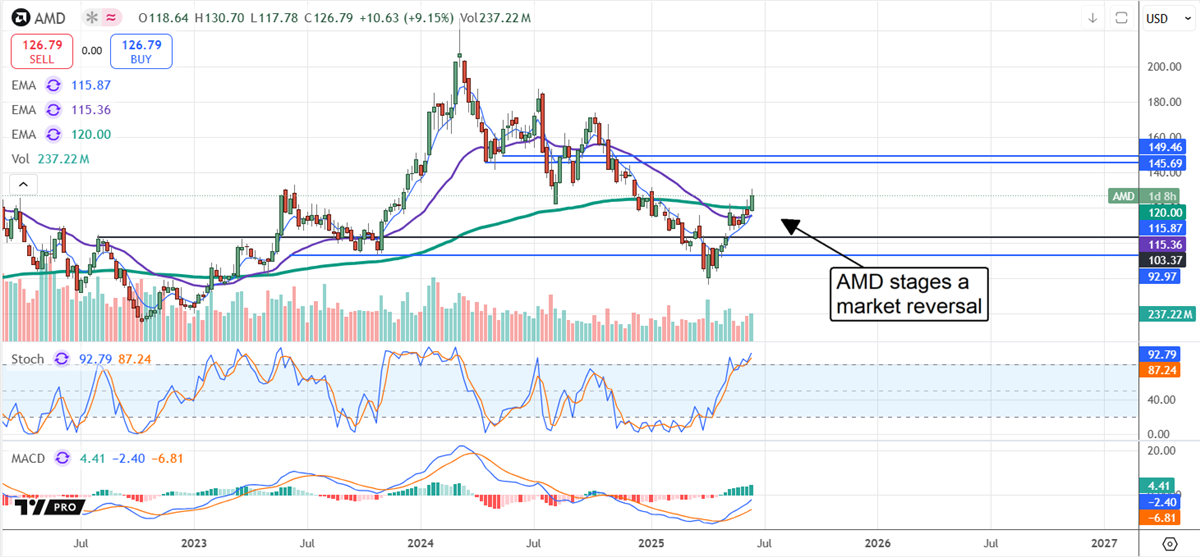
Advanced Micro Devices (NASDAQ: AMD) is among the interesting buys reported by Marjorie Taylor Greene. Notable because the stock hit bottom earlier this year and rebounded strongly, and because it is the 6th Most Bought Stock by Congress, as reported by MarketBeat. Another interesting tidbit is that NVIDIA (NASDAQ: NVDA) is nowhere to be found in the ranks. Congress, collectively, holds a sizable position in the company but has made no significant purchases this year.
AI drives Advanced Micro Devices’ market rebound. It took 18 months for AMD’s AI reality to catch up with market expectations, but it has now done so, and it is gaining momentum.
The company is heavily investing in the development of its GPUs and its entire stack, enhancing its capabilities, go-to-market strategy, and appeal to end-markets, which is a significant investment. AMD GPUs offer numerous advantages over NVIDIA, which is why they can take market share over time.
Marjorie Taylor Greene Times the Bottom for UnitedHealth Group
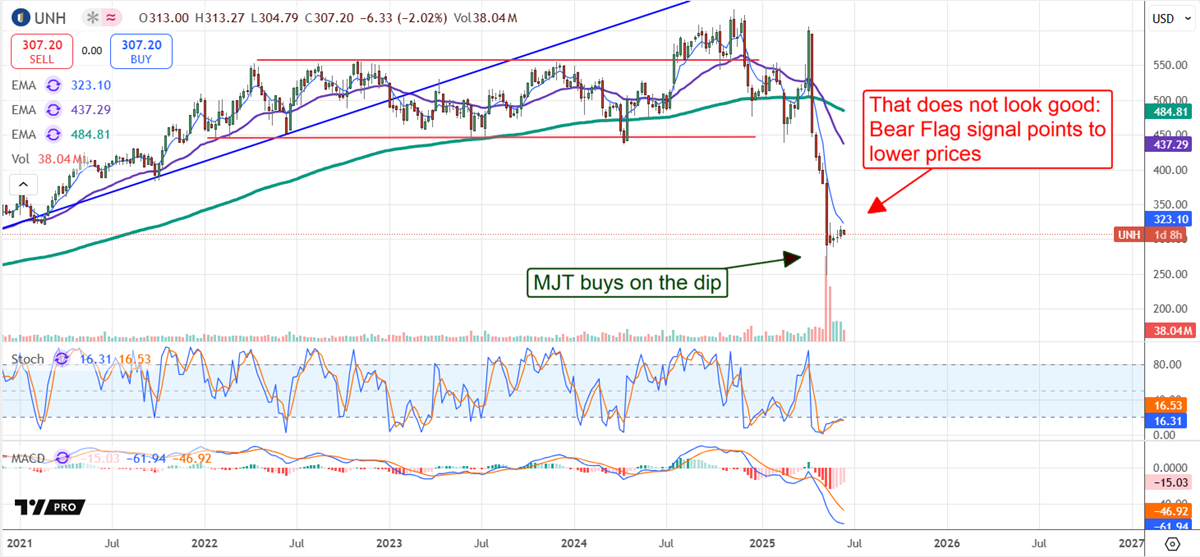
Marjorie Taylor Greene's standout trade is a purchase of UnitedHealth Group (NYSE: UNH). UNH shares shed more than 50% in a matter of weeks, driven by a robustly negative news cycle. She bought at the lows of the movement on May 14 and 16. However, she is not the only one.
UNH stock’s trading volume on those days was at record levels, marking a likely bottom for the sell-off. UNH is also on the list of Congress's Most Bought stocks, with eight members purchasing it eight times during the second quarter. The question now is whether the company can overcome its hurdles, including its CEO's departure, a fraud investigation, and rising costs.
Analysts' sentiment is part of why UNH's share price fell as hard as it did. MarketBeat tracks numerous downgrades and price target reductions that shaved 30% off of the consensus target in under 90 days. However, the consensus sentiment remains firmly pegged at Moderate Buy with a bullish bias and a price target forecasting a 40% upside. In this scenario, UnitedHealth Group stock is set up to stage a significant rebound, provided a catalyst emerges. Until then, the company remains in growth mode with healthy cash flow and margin, sustaining a reliable dividend.

Gold is soaring. Here's how to get paid from it
Gold is soaring. Here's how to get paid from it

MarketBeat Media, LLC dba TickerReport
345 N Reid Place, Suite 620, Sioux Falls, SD 57103.
Post a Comment
Post a Comment