You are a free subscriber to Me and the Money Printer. To upgrade to paid and receive the daily Capital Wave Report - which features our Red-Green market signals, subscribe here. Hey... They're Catching On... (The Week in Review)A beautiful day in Maryland gives us an opportunity to reflect on the last week of volatility and other silliness...
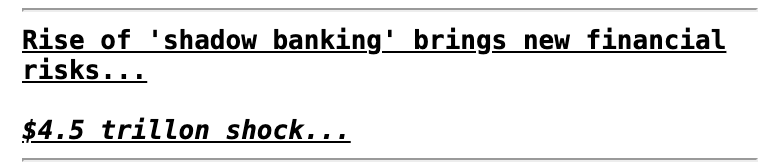
Dear Fellow Traveler: Well… the Blue Dolphins finished their regular season today… and the Under-8 girl’s team (featuring Amelia) lost 4-2… in another difficult game. We finished the season with one win… from the game that Amelia and I missed… As one of the coaches, we do our best to let all of the kids play different positions. Our opponents, however, kept their best forward in - right up front - the entire game. She scored three goals... We enter the playoffs next week against the No. 2 seed. I’m very tired… and spent a lot of time napping today (very overdue). So, now that I’m playing catch-up… Looking at charts and reading for an hour… I can’t help but notice an article that’s on the front page of the Drudge Report… It reads…
Wait a minute… Washington Post… the rise of “shadow banking?” Where Have These People Been?The Washington Post headline treats shadow banking as a shocking new development after a few fraud cases hit regional banks this week. “Rise of shadow banking,” they breathlessly report. Rise? What the hell have these people been doing since 2008? Shadow banking has been larger than traditional banking for over fifteen years. Zoltan Pozsar, former Fed researcher and shadow banking expert, documented how this parallel financial system grew to dwarf regular banks after the 2008 crisis. Michael Howell at CrossBorder Capital has shown how shadow banking now represents the majority of global credit creation. Yesterday, Howell asked a question that I’ve been discussing for about a month… “Will Quantitative Easing come back?” Shadow banking isn’t new… It’s been responsible for practically every major financial crisis of the last 30 years… The Asian Financial Crisis? Shadow banking channeled short-term foreign capital into long-term local projects, leading to maturity mismatches and sudden capital flight. Long-Term Capital Management in 1998? Shadow banking. This was a leveraged hedge fund that threatened systemic liquidity. The Fed had to arrange a private bailout. The 2008 mortgage meltdown? Shadow banking through structured investment vehicles and off-balance-sheet entities. Things like Structured Investment Vehicles (SIVs), asset-backed commercial paper programs, and mortgage securitization trusts expanded significantly. By 2007, the U.S. shadow banking system was larger than the regulated banking sector. In 2011, shadow conduits included money market funds and repo counterparties financing peripheral sovereign debt. Haircuts and collateral runs deepened stress in the European Banking System for banks reliant on wholesale shadow funding. In March 2020, the Fed had to create the Money Market Mutual Fund Liquidity Facility and buy corporate bonds/ETFs to backstop shadow credit. In 2021, Archegos, a family office using total return swaps with prime brokers (outside bank balance sheets) imploded. This caused $10+ billion in losses to major banks. China’s Evergrande crisis this decade? The property developer’s collapse exposed the massive role of shadow lending and trust financing in China’s real estate bubble. The 2022 GILT Crisis in England? Pension funds using leveraged derivatives strategies (repo and swaps) faced margin calls after gilt yields spiked. The Bank of England had to intervene with emergency gilt purchases to prevent a collapse. Every boom-bust cycle traces back to unregulated credit creation outside traditional banking oversight. You can even debate the 1907 Knickerbocker Trust Crisis as a shadow banking disaster that eventually led to the Federal Reserve’s creation… So, What’s Happening Now?Regional banks are under pressure… and once again… there are concerns about banking reserves falling to levels that could trigger problems in the overnight lending markets… Zions Bank is losing $50 million on fraudulent loans, JPMorgan is taking $170 million hits on auto lender Tricolor Holdings, and regional banks are getting burned by “private credit…” The real story isn’t isolated fraud cases. It’s that “private credit” and “non-depository lending” are euphemisms for the same shadow banking system that’s been quietly financing everything the regular banks won’t touch. When traditional banks can’t make money under regulatory constraints, the shadow banks take on the risk… the banks just originate everything… On Tuesday, Jamie Dimon referred to other problems in the economy during JPMorgan’s earnings call, suggesting that “when you see one cockroach, there are probably more.” But these aren’t isolated cockroaches. They’re part of a massive parallel financial system that’s been growing in the shadows while regulators pretended it didn’t exist. The only surprise is that anyone’s surprised… At least these journalists are trying to educate people… but they’re decades late to the party… and always behind when the crisis actually hits… Now… let’s take a look at the week in review… Monday, October 13 How to Make Money Selling Dreams, Not Digging DirtDon’t chase gold… grab the royalty streams instead…
Tuesday, October 14 And We’re Yellow Again... With Markets Shrugging Off Common Sense...Valuations aren’t the real story. The issue is still in the regional banks and the financials that are tied to private credit. People are getting nervous again…
Wednesday, October 15 The White Swan Everyone IgnoredDid people really think that gold’s rise to $4,000 was a surprise? Unpredictable?
No… the reasons for gold’s massive 2024-2025 returns were obvious… Thursday, October 16 Answers to Bernie Sanders’ Questions on CNN...Some people had some opinions on my take… but everything’s open to debate…
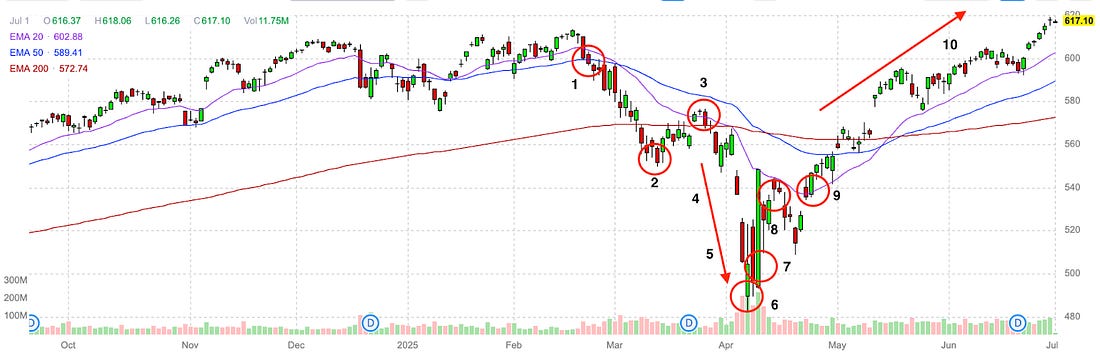
Friday, October 17 Little Late This Morning...Remember… if we go negative… we’ll likely see this pattern… This is the crisis pattern…
Follow the insider buying as it arrives… Stay positive, Garrett Baldwin About Me and the Money Printer Me and the Money Printer is a daily publication covering the financial markets through three critical equations. We track liquidity (money in the financial system), momentum (where money is moving in the system), and insider buying (where Smart Money at companies is moving their money). Combining these elements with a deep understanding of central banking and how the global system works has allowed us to navigate financial cycles and boost our probability of success as investors and traders. This insight is based on roughly 17 years of intensive academic work at four universities, extensive collaboration with market experts, and the joy of trial and error in research. You can take a free look at our worldview and thesis right here. Disclaimer Nothing in this email should be considered personalized financial advice. While we may answer your general customer questions, we are not licensed under securities laws to guide your investment situation. Do not consider any communication between you and Florida Republic employees as financial advice. The communication in this letter is for information and educational purposes unless otherwise strictly worded as a recommendation. Model portfolios are tracked to showcase a variety of academic, fundamental, and technical tools, and insight is provided to help readers gain knowledge and experience. Readers should not trade if they cannot handle a loss and should not trade more than they can afford to lose. There are large amounts of risk in the equity markets. Consider consulting with a professional before making decisions with your money.
|










Post a Comment
Post a Comment