| 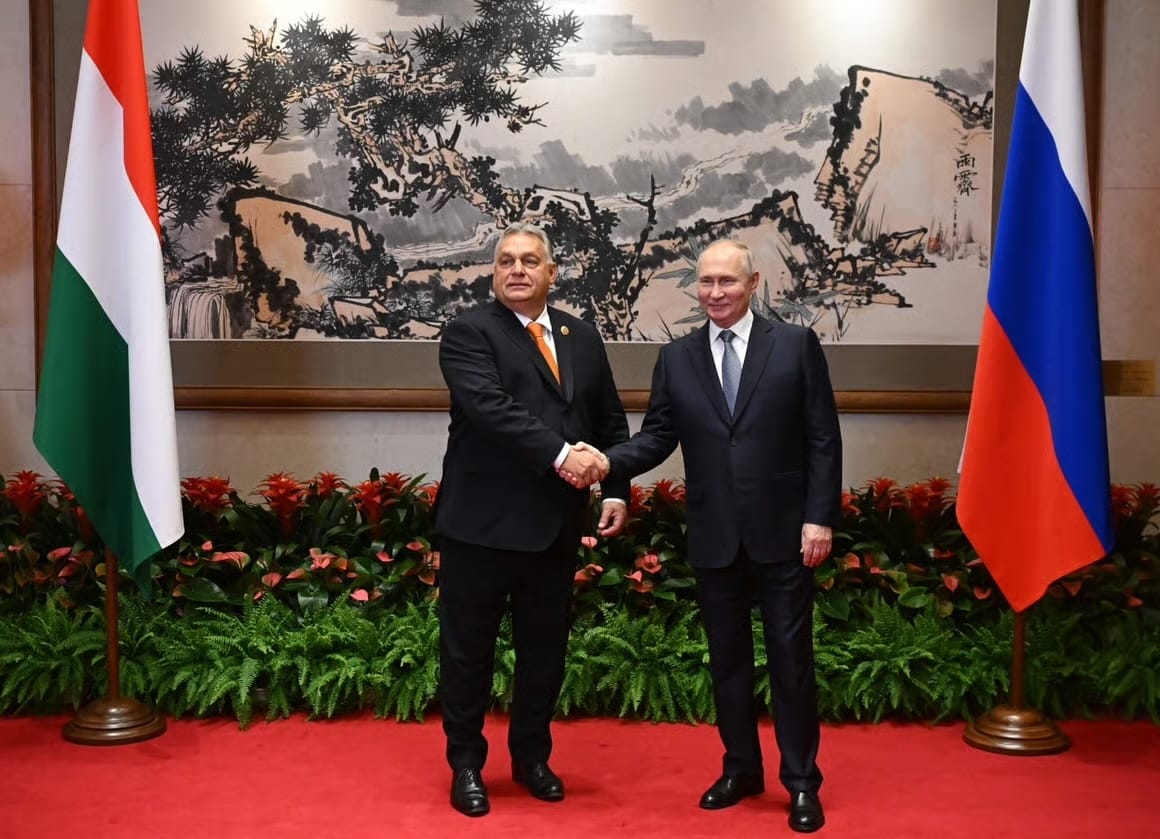 | Viktor Orban (left) and Vladimir Putin (right) (Source: Politico.eu) |
| Hungary and Russia share a long and tough history. This continues to shape their relationship today. The story of these two states is one of power, memory, and strategy. Hungary often finds itself caught between stronger forces. Russia seeks to expand its influence across Europe and beyond. Their ties reflect the struggles between interests and alliance loyalty. | Historical background | These states' relation is shaped by history. After World War II, Hungary fell under USSR control. USSR used its power to shape Hungary's government, economy, and foreign policy. Hungarians rose up in a revolution for freedom and independence from Moscow. Soviet troops invaded and crushed the uprising. They killed thousands and forced many more to flee. This event left deep scars in Hungary's national memory. It made many people distrust Russia. | When the USSR collapsed, Hungary saw a chance for change. It turned toward the West. It joined NATO in 1999 and the EU in 2004. For many, these moves were a path toward democracy, freedom, and economic progress. But history has a long shadow. Russia never fully disappeared from Hungary's political and economic landscape. | | | Congress to feature Trump on $100 Bill?
A shocking new plan was just introduced in Washington. The idea is to celebrate Trump's new "golden age" by placing him on the $100 bill.
As you'll see, it has little to do with the new Crypto Reserve…
Or Trump's ambitious plan for Artificial Intelligence…
Former Presidential Advisor, Jim Rickards says, "Trump's crowning achievement will be much, much bigger."
In the months ahead, he predicts, the government will release a massive multi-trillion-dollar asset which it has held back for more than a century. And this will give ordinary investors a chance to strike it rich.
Click here to see the full details. |
|
| | Energy ties | One of the strongest links between Hungary and Russia is energy. Hungary relies on Russia's oil and natural gas. This gives Russia influence over Hungary's economy and politics. The two countries have built long-term contracts for gas supplies. Russia also has helped fund the expansion of the state's only nuclear plant in Paks. | For Hungary, the deals with Russia on energy are crucial. The state has limited natural resources of its own and must import most of its fuel. Russia's energy is also often cheaper and easier to secure. But these ties also create weaknesses. If tensions rise, Moscow can use energy supplies as a tool of pressure. | The EU has tried to reduce reliance on Russia's energy since the war in Ukraine. Many EU members have turned to other sources. But Hungary has taken a slower approach. Its leaders argue that cutting off Russia's energy too quickly would harm their state. As a result, Hungary continues to buy Russian oil and gas. | Hungary's foreign policy under Viktor Orbán | For the past fifteen years, PM Orbán has led Hungary. His government focuses on sovereignty, conservative values, and centralized power. Orbán often speaks against what he sees as Western interference in his state's affairs. This approach has caused friction with the EU and other NATO allies. They blame him of hurting democratic bodies and media freedom. | Orbán has also pursued closer ties with Russia. He calls for cooperation instead of confrontation. He has met with Putin many times and supported joint projects in energy, trade, and culture. While most EU leaders distanced themselves from Russia, Orbán has chosen to stay close. | Hungary has voted for many EU sanctions against Russia. But it often delays or weakens them. The government says it wants peace in Ukraine. But it also insists that Europe should avoid policies that damage their own economies. This stance has made Hungary appear as one of Russia's few friendly voices inside the EU. This led some to label it as Moscow's "Trojan horse" in Europe. | Domestic and regional impact | Inside Hungary, views on Russia are mixed. Older people lived under the USSR era. They view Russia with suspicion. Others see these ties as a way to secure cheap energy and protect their interests. Orbán's media and leaders often say the war in Ukraine is a distant problem. They argue their state should not sacrifice its economy for someone else's war. | In Central Europe, Hungary's stance contrasts sharply with that of its neighbors. Poland, Slovakia, and Romania have backed Ukraine. They called for tough action against Moscow. This difference has created tension within regional alliances. While these states see Russia as a direct threat, Hungary prefers a neutral or balanced approach. | Challenges and future prospects | Hungary's balancing act between East and West is becoming harder to keep. On one hand, Hungary benefits from EU membership. It receives billions of euros in development funds. On the other, it wants to keep cheap energy and trade deals from Russia. If the war in Ukraine continues or escalates, pressures to pick a side will increase. | Hungary may have to diversify its energy sources. It also may have to strengthen ties with EU partners to ensure security. At the same time, Russia will likely continue to use its leverages to keep Hungary close. The question is whether Hungary can keep this middle position without losing trust from its Western allies or becoming too dependent on Moscow. | Decoding geopolitics isn't a job. It's survival. | Joy |
|


Post a Comment
Post a Comment