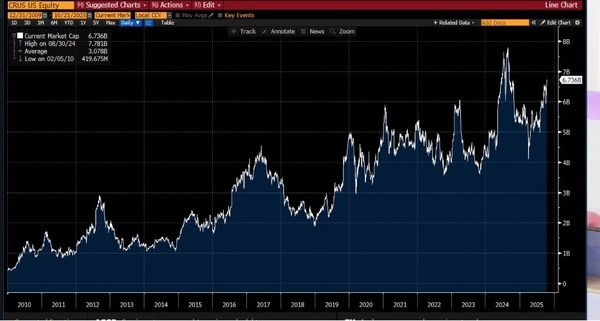
| No. 1: Smartphones - Little Chips, Big Paydays The iPhone/Android boom lifted a cottage industry of small component makers. Radio frequency (RF) and power chips routed wireless, Wi-fi, and bluetooth signals inside tight phone designs. Audio and haptics chips made devices sound and feel better. Sensors (gyros, accelerometers, image sensors) enabled features like better cameras and motion control. Most consumers never hear these companies' names. But if you sell a small part that ships in hundreds of millions of phones, your flywheel spins fast. Cirrus Logic (Nasdaq: CRUS) is a clear example. Cirrus designs high-performance audio chips - codecs and amplifiers that sit between a phone's processor and your ears. Any time you hit play, place a call, or record a video, those parts go to work. Cirrus' audio silicon shows up in iPhone teardowns over many generations, underscoring how sticky these "designed-in" sockets can be. The company broadened from codecs into amplifiers and other high-performance mixed-signal niches, and later added power/fast-charging integrated circuits (ICs) - the chips that negotiate USB-C/PD, step voltage up or down, and safely charge the battery - by acquiring Lion Semiconductor in 2021. Since early 2010, Cirrus' market cap grew from around $420 million to nearly $7 billion today. The lesson: you didn't need to pick the winning phone brand. Owning a core supplier that shipped into the winners - year after year - was enough. No. 2: E-Commerce and Automation - Quiet Hands on the Levers "Buy now, ship today" created demand for: - Barcode/vision systems and warehouse software
- Conveyor, sortation, and robotics sub-systems
- Packaging and other consumables that get reordered on a schedule
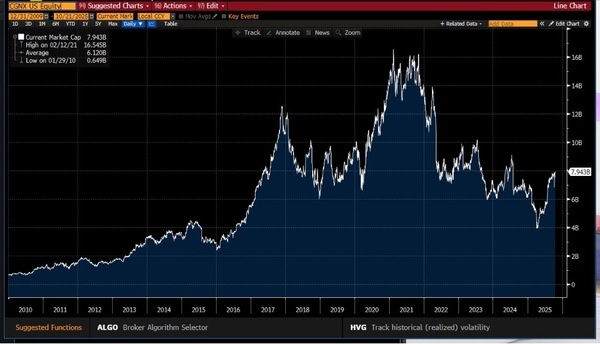
Many small firms grew by landing one anchor customer, then a second, then a network of integrators. Recurring service and consumables turned lumpy orders into steadier revenue. Cognex (Nasdaq: CGNX) is a great example. Cognex makes machine-vision gear - high-speed barcode readers, 2D/3D cameras, and vision software that sits on conveyor lines and robotic cells. In simple terms, Cognex helps automated systems see and ID parcels and products so they can be routed, sorted, picked, and verified. In 2010, Cognex was a niche industrial name. As e-commerce scaled, fixed-mount readers and vision tunnels rolled out across parcel carriers, 3PLs, and big retailers. That steady, repeat demand helped move Cognex from small-cap status into mid-cap territory over the cycle. Between early 2010 and early 2021, Cognex's market cap grew from around $650 million to more than $16 billion. No. 3: Cloud Computing - The Data-Center Supply Chain As businesses moved from server closets to the cloud, suppliers rode a long spending cycle... - Optical modules to move data faster inside and between data centers
- Power/uninterruptable power supply and switchgear to keep servers humming
- Thermal solutions to pull heat from dense racks
Some started as niche contract manufacturers. With each new build, they added stock keeping units (barcodes), lines, and customers - and a few became category leaders. Fabrinet (NYSE: FN) is a clean example. Fabrinet builds high-precision optical components and assemblies, including large volumes of optical transceivers used in cloud data centers. From 2012 to today, the cloud's data links marched from 40G to 100G to 400G, with 800G entering production - exactly the kind of multi-year upgrade path that boosts volume and average selling prices for complex optics. Big equipment makers leaned on Fabrinet for scaled assembly, turning pilot orders into multi-year programs across customers. Utilization improved - and profits followed. Since late 2012, Fabrinet's market cap has grown from around $322 million to more than $14 billion today. The Next Hidden Index Is in Plain Sight AI is moving into daily use. The spotlight now is on inference - the always-on running of models in apps, cars, factories, hospitals, and phones. Every boom mints a quiet class of winners. In smartphones, it was socket-winning chipmakers. In cloud, it was optics, power, and thermal. In AI, it's likely those same categories, scaled up for bigger, hotter, hungrier compute. You don't need to out-guess which model wins. You only need to own the suppliers that get paid every time someone uses AI. That's the hidden index. Want ideas? The Oxford Club's Chief Investment Strategist Alexander Green and Chief Income Strategist Marc Lichtenfeld have built a tight roster of backstage AI players... I'm talking about seven small vendors that handle the lighting, power, routing, and logistics every big act needs. If you want the full lineup (plus the marquee pick they're giving away), catch their Micro Mag 7 Summit here. If you'd rather own the tour than gamble on the next superstar, that's your next stop. Good investing, Kristin | 




Post a Comment
Post a Comment