You are a free subscriber to Me and the Money Printer. To upgrade to paid and receive the daily Capital Wave Report - which features our Red-Green market signals, subscribe here.
Dear Fellow Traveler, Picture every Fox Business panel you’ve ever watched. The host asks, “Where do you see the best opportunities today?” The participants all give the dumb look of a substitute teacher who just found out today’s class is AP Calculus. One person says “valuation” like he’s reciting a safe word… Another says “earnings visibility” the way you’d say “Pretty sure this is poison.” The third guy shoves “AI” into his answer because he knows his boss watches. [All three happened with an analyst in minutes on CNBC this morning, by the way…] In this example, we have multiple people in expensive suits playing hot potato with a question nobody wants to catch. It’s why I don’t watch or listen to them. Instead, I pay attention to the one group that never… ever… gets to waffle, hedge, or fill airtime. Corporate Insiders. We’re talking about the CEOs, CFOs, and board members who run companies. They don’t watch from the outside. They have desks… with nameplates…and get their birthdays off (though none of them actually take the day off). Executives can’t hide behind stories or charts. They can’t blame “macro headwinds” or “the consumer” when things go wrong (unless they’re Oxford Industries). Executives either buy their own stock or go back to pretending the price-to-earnings ratio matters. That single action (buying or not buying) tells you more about what’s really happening than 80% of the “analysis” you hear on television. Before we get into the weeds, let’s put a clean definition on the table so we’re talking about the same thing. Let’s Define ThisNow… I’m not talking about “insider trading” in the illegal, go-to-jail sense. I’m talking about insider buying that is the legal, publicly-reported kind, where executives buy stock in their companies and must report it to everyone. When executives buy their own stock, they’re putting their money on the line (hard cash with direct purchases). They’re not on air making analogies or excuses. They’re not pointing to a chart and saying, “The trend is your friend.” When they buy, they use Form 4 documents that you can track on SEC EDGAR if you have the time (we do over at the Insider Buying Report… sign up for free) Insider buying is a critical piece of the Waterfall framework we discussed on Tuesday. So it goes… Liquidity. Momentum. Insider Behavior (And Policy). Insiders buy for one main reason… they believe conditions are about to get better. And when conditions get better, money flows more freely. And when money flows more freely, stocks go up. This isn’t rocket surgery… What Insider Buying MeasuresMost journalists will write that insider buying feels like a “vote of confidence” in their company. That’s half true… and irrelevant at the macro level. Insider buying really measures timing. Executives live closer to the action than everyone else, so they experience the economic changes before regular investors do.
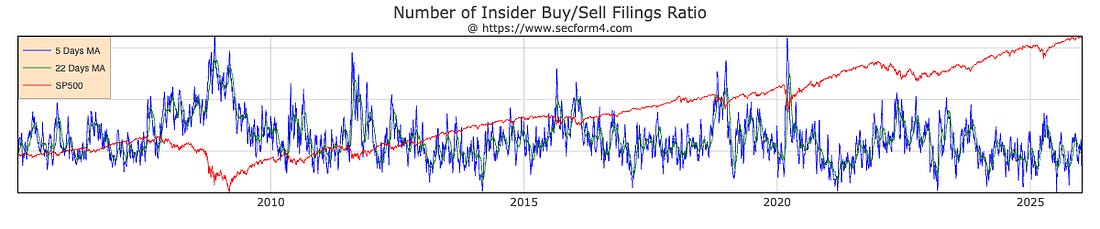
CEOs feel tightening credit before the rest of us. The CFO feels it even faster because he’s the one refreshing the company’s bank dashboard. And board members? They show up when they smell opportunity and vanish when they smell smoke. These aren’t people waiting on government reports or economists to predict 15 recessions in a row or claim that we’ve beaten inflation... They feel the change coming, and they vote with their money... That’s why insider buying isn’t really just a stock signal. It’s a system signal. At the aggregate level, it can tell you when the machine is about to turn on again. And the research proves it. No Fairy DustInsider buying is one of the most heavily studied phenomena in finance. Professors have been picking it apart for decades… and I had the chance to study with one of the best in the bunch: Ken Carow at Indiana University. Now, a lot of data shows that insider buying leads to greater alpha. It will tell you about different ways to focus on individual stocks, what executives to follow, and everything else that’s been studied at the microeconomic level. I love that stuff… and it works. But in the Waterfall Strategy… I want to show you why it is so important at the macro level when we combine it through the lens of liquidity and equity momentum. Let’s just cover a few academic parts first… 1. Insider Buying Predicts Where the Market Is Going A researcher named H. Nejat Seyhun published a landmark study in 1992. He found that if you add up all the insider buying and selling across the entire stock market, it predicts about 60% of what the market will do over the next 12 months. Again, that’s 60%, not at the individual stock level, but at the entire market level… That’s exactly why we follow insider buying-to-selling at the aggregate level… Yes, it matters, especially at the aggregate level. 2. Insiders Trade More When Big Changes Are Coming Xiao Li examined insider trading across 22 countries in 2020. He found that insiders trade more actively when there’s uncertainty about government policy, whether it’s rising or falling. Did you hear that? When government policy is about to shift… the insiders like to move quickly… Doesn’t matter if it’s QE, new bank lending, new Treasury issuance, interest rates going up or down, or trade policy shifts. It’s all one and the same. POLICY changes (The subject of Money Printer 104 tomorrow). Again… this is why we’re focused on the aggregate… more on that in a moment… 3. The Big Bosses Move First B. Lambe published a study in 2022 showing that CEOs and CFOs act faster than other insiders when conditions are shifting. They smell the change in the air before anyone else notices the breeze. Again, we put the focus right on the top two executives in the company. No one knows the business better than the CEO, and no one knows the balance sheet better than the CFO. They feel things before they see them… Bill Walton-style, describing a sunset like it’s a spiritual awakening. How This Connects to Everything ElseIf you’ve been following along, you’ve heard me say before: Liquidity is the cause. Momentum is the effect. Returns are the result. Liquidity acts like water pressure… giving you permission to get in your boat and ride upriver. When the pipes open up, everything else moves. And when the pipes are closed, well… your boat might get stuck in the mud. And when it’s back up again… everyone becomes an expert in plumbing. Meanwhile, as we explained yesterday, momentum isn’t magic. Momentum is a condition… or derivative… of expanding and contracting market liquidity. Now… here’s the thing that I’ve argued for a while. Insiders are real-world confirmation that the liquidity plumbing beneath the market is changing. Boards pay consultants to watch monetary and fiscal policy like beavers staring at trees, guessing which one falls next. Insiders have a preternatural ability to buy BEFORE conditions improve. Not after. It’s in the academic data… and it’s in the charts… so I don’t really feel the need to convince you. Here’s the historical chart of insider-buying-to-selling at the aggregate level dating back to 2005. See the big spikes before 2025? That’s executives calling the bottom of major market shifts… When you map insider buying-to-selling ratios over time, the pattern becomes impossible to ignore.
These big spikes before 2026 all align with major policy shifts that were accommodative to the equity markets (I’ll address the spike on the right in a moment). It’s important to note that it’s not just at the company level. We don’t have to focus on one person… because they’re not all psychic. In fact, some executives are good at buying, but bad at other things… Since executives are human, they make mistakes… often breathtaking ones. Have you seen some of these people? Kodak’s CEO sent conspiracy theory texts… Intel’s CEO said that Taiwan was not a country… on CNBC. A Tesla VP was live-streaming while driving… and the autopilot disengaged… Peloton’s CEO said that gyms were obsolete… And let’s not get started on Bud Light (Ambev). My point is that they’re not all brain surgeons… They make mistakes, and they’re human. Which makes my case for insider buying that much stronger because it showcases that insider buying-to-selling on the aggregate is a powerful tool. Think about it step by step: Money starts flowing more easily through the system as banks loosen lending standards and the Fed or Treasury accommodates… Companies can borrow at better rates…. Customer orders start coming back. The future gets easier to predict. Then insiders step in. They don’t wait for CNBC to run a segment about the “improving outlook.” They move first. The strongest levels of insider buying tend to coincide with the Fed changing direction, policy becoming accommodative, a crisis starting to calm, and the market hitting a bottom. Insiders buy when the storm surge is moving out, not when the sun is already shining. 1. It shows conviction 2. It shows timing 3. It shows that things are changing Now. I’ll be honest… insider buying won’t tell you which stock will outperform the rest. But when you combine it with money flow and momentum health, you start to see the whole picture. Not the one they show you on TV. The real one. Look at this chart… It’s the aggregate buying (Ignore the spike on the far right — that’s a data glitch I’ve already addressed.)
So, we bring in the insider buying-to-selling filing chart to line up with the dollar amounts.
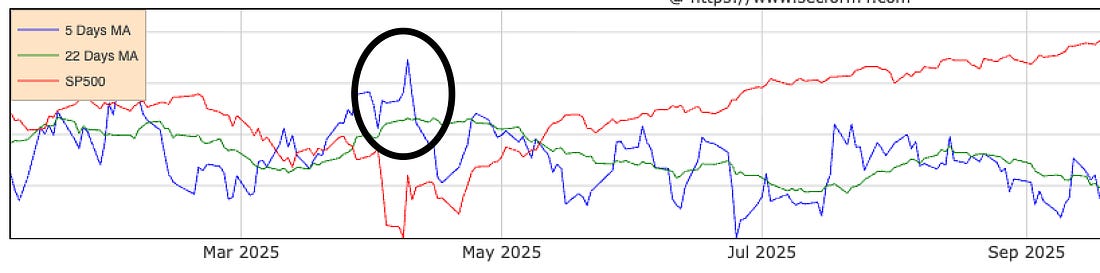
We end up with a much cleaner picture… 2009 and 2011The Great Financial Crisis and the European Banking Crisis… Pretty simple. Big policy shifts aligned with insider buying. The spike that’s there… the three big ones on the left are after Lehman Brothers, the start of QE 1 in March 2009, and the Fall 2011 policy shift by the European Central Bank. 2016: The China PanicHere’s how the pattern has played out across different crises and regimes. China devalued its currency, and markets freaked out. Insider buying spiked during the February bottom. Money conditions improved. Momentum came back. Markets took off. This was the strongest insider-buying-to-selling ratio in real dollars in the 20 years of this chart. Most people didn’t even realize what was happening in China, and they missed it when the accommodation started… 2020: The COVID CrashInsider buying exploded in March 2020. While everyone else was panic-selling and arguing about whether to wipe down their mail, insiders were loading up. Jamie Dimon bought $26 million in JPMorgan stock. That’s not confidence. That’s a man who saw the Fed’s bat-signal in the sky. The Fed printed $5 trillion. Momentum exploded, and the market ripped for two straight years. It was one of the greatest examples of a K-shaped recovery ever. Americans panicked and sold, and executives bought their stock right as the central bank started dropping money from the sky. 2024: The Japan ScareIn August 2024… the Japanese stock market crashed, dragging everyone down with it. Then Japan’s central bank calmed everyone down, and insiders reappeared. Momentum came back. The pattern keeps repeating, across crises and across cycles. 2025: Liberation Day and the Japan StimulusAs I noted in the Capital Wave Report on April 9, insider buying spiked to its highest levels of the year as the President addressed ongoing trade problems. Leveraged hedge funds were dumping bonds, and correlations were starting to move to 1. That’s when things are ripe for a pivot. Actually, that’s not correct… conditions are usually about to improve when everyone starts predicting the Great Depression is coming…
Well… what happened? Insiders bought… policies changed… we provided accommodation to leveraged funds… and equities took off fast. It was mechanical.
Then, at the height of our latest repo spasms in November, we began to see concerns about a market crash and an implosion in the regional banking sector. Not so fast, said the insiders. Back on November 20, insider buying started to pick up at the strongest pace since April 2025… The next day, Japan announced a massive stimulus package to shore up its financial situation. Two weeks later, the U.S. Federal Reserve announced it would buy $40 billion in short-term T-bills each month to stabilize the banking system.
Insiders were out in front of BOTH situations this year. (Note, ignore that spike in December, it is an anomaly that I addressed because of an incorrect data point.) What Insider Buying Really Tells YouInsiders don’t buy because CNBC said the market was “stabilizing.” At the aggregate, they buy into strong money conditions. That’s the whole game. Their timing isn’t based on stock prices. It’s based on whether the system can support those prices going higher. They buy when the machine is about to work in their favor. And they stop buying when that support disappears. Liquidity is the cause. Momentum is the effect. Insiders are a weather vane. Insider buying doesn’t predict the future. It tells you when the present is about to flip. If you’re interested in Insider Buying, we have a letter that goes out each morning called The Insider Buying Report. It tracks significant, direct insider buys each day and gives traders an active portfolio of recommendations each week. You can get a deal on it… right here… We’ll be back tomorrow to talk about what policy accommodation means… Then we’ll finish on Friday with a summation of our learnings from this week. Stay positive, Garrett Baldwin Sources Seyhun, H. N. (1992). “Why Does Aggregate Insider Trading Predict Future Stock Returns?” Quarterly Journal of Economics, 107(4), 1303-1331. Li, X. (2020). “The Impact of Economic Policy Uncertainty on Insider Trades: A Cross-Country Analysis.” Journal of Business Research, 119, 41-57. Lambe, B. (2022). “Uncertain Times and the Insider Perspective.” Journal of Financial Research. About Me and the Money Printer Me and the Money Printer is a daily publication covering the financial markets through three critical equations. We track liquidity (money in the financial system), momentum (where money is moving in the system), and insider buying (where Smart Money at companies is moving their money). Combining these elements with a deep understanding of central banking and how the global system works has allowed us to navigate financial cycles and boost our probability of success as investors and traders. This insight is based on roughly 17 years of intensive academic work at four universities, extensive collaboration with market experts, and the joy of trial and error in research. You can take a free look at our worldview and thesis right here. Disclaimer Nothing in this email should be considered personalized financial advice. While we may answer your general customer questions, we are not licensed under securities laws to guide your investment situation. Do not consider any communication between you and Florida Republic employees as financial advice. The communication in this letter is for information and educational purposes unless otherwise strictly worded as a recommendation. Model portfolios are tracked to showcase a variety of academic, fundamental, and technical tools, and insight is provided to help readers gain knowledge and experience. Readers should not trade if they cannot handle a loss and should not trade more than they can afford to lose. There are large amounts of risk in the equity markets. Consider consulting with a professional before making decisions with your money.
|










Post a Comment
Post a Comment