| "Little else is required to carry a state to the highest degree of opulence but peace, easy taxes, and a tolerable administration of justice."
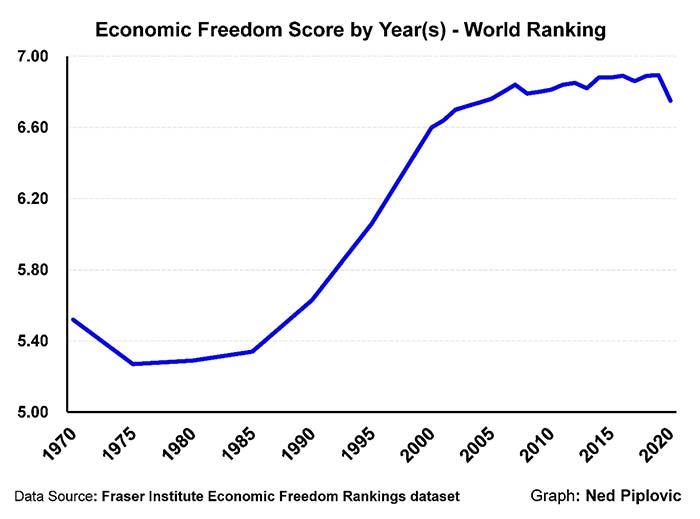
- Adam Smith Today is an important day as we approach the 250th anniversary of our nation's founding. On March 9, 1776, the most important book ever written on the road to prosperity was published in Great Britain, which was still America's motherland at the time. Written by a quiet but influential Scottish professor named Adam Smith, it is called The Wealth of Nations. It was the intellectual shot heard around the world - a declaration of economic independence. The Scottish philosopher predicted untold riches for any country that adopted what he called his "system of natural liberty." What was his message? Give citizens their economic freedom - what we might today call "democratic capitalism"! In his system of natural liberty, every man is "free to pursue his own interest" under robust competition with minimal government interference. In the very center of The Wealth of Nations, he called it "the invisible hand" of liberty. Today we call it free-market capitalism, free enterprise, or laissez-faire. Natural liberty includes the right to buy goods from abroad without tariffs or import quotas... the right to choose your own occupation... the right to set your own prices and wages... and the right to save and invest your capital without government restraint. Economic and political freedom was rare in those days, but under the influence of The Wealth of Nations, many nations have gradually adopted the Adam Smith model, as evidenced by the rise in the Fraser Institute's Economic Freedom of the World index. According to former Fed Chairman Alan Greenspan, America adopted Adam Smith's formula for success more than any country, especially after it won its hard-fought war for independence. Within 100 years, the United States became, as Smith predicted, the "most formidable" nation on Earth, even surpassing the British empire in influence. Adam Smith promised freedom and prosperity to countries that adopted three policies: "peace, easy taxes, and a tolerable administration of justice." Most of the time, the United States has done just that. As Ben Franklin wrote, "The system of America is universal commerce with every nation; war with none." The U.S. Constitution provided peace, prosperity, and stability from sea to shining sea. For over two centuries, we have enjoyed the benefits of a stable democratic republic and limited government. The Constitution provided a model for a "tolerable administration of justice" and peace and commerce between nations and the states with few exceptions. It prohibited tariffs and duties between states so that the United States became a gigantic free-trade zone. It also gradually reduced tariffs and became the powerhouse of globalization. If he were alive today, Adam Smith would be pleased with the incredible growth and higher standards of living, especially after the collapse of the Berlin Wall and the Soviet socialist model. Free trade was his biggest success, as nation after nation lowered trade barriers and enjoyed the benefits of globalization. In an age of protectionism, Adam Smith boldly declared, "If a foreign country can supply us with a commodity that is cheaper than we ourselves can make it, better to buy it of them." The Bull Market Is Threatened in Two Ways But beginning in the 21st century, the Economic Freedom of the World index has slowed down or declined. The Adam Smith model has come under attack by Keynesians, Marxists, and interventionists who want a return to top-down policies of authoritarian government, deficit spending, tax hikes, "fair trade," and overregulation, all in the name of fairness, equity, and saving the planet. No longer are there "peace, easy taxes, and a tolerable administration of justice," but rather, a renewal of protective tariffs (the highest in a century); wars breaking out in Ukraine, Russia, Iran, the Middle East, and Latin America; and strongmen ignoring the democratic process. This year, the stock market has struggled against the backdrop of two new threats: a renewed trade war and growing geopolitical instability. Right now, only gold is holding up. Make sure you have gold in your portfolio. Yet, like Adam Smith, I remain optimistic. He wrote 250 years ago, "The uniform, constant, and uninterrupted effort of every man to better his condition... is frequently powerful enough to maintain the natural progress of things toward improvement, in spite both of the extravagance of government, and of the greatest errors of administration." Long live Adam Smith! | 










Post a Comment
Post a Comment