| Swan Dive — March 9, 2026  If you sensed that something shifted while you were pouring coffee this morning, you’re not wrong. Oil had spiked to over $119 a barrel, only to drop back below $100… then started rising again.
As our strategic analyst John Robb suggested last week on Grey Swan Live!, the “kinetic decapitation” of the regime in Tehran was only the beginning of the story. The Iranian Revolutionary Guard has now decentralized command and is fighting an “asymmetric” existential war.
The S&P 500 fell 2% last week — its worst week since October. And the VIX logged its largest weekly move since the April 2025 selloff. The U.S. dollar posted its strongest weekly gain since October 2024 as global capital moved toward liquidity and settlement depth. But the real focus was on black goo.  Oil made history. WTI crude surged from roughly $67 to $119 in a single week — a 42% jump and the largest weekly increase on record going back to 1990. Brent traded above $100.
By long-term momentum measures, crude is now more overbought than at any point in the last three decades.
In six of the past eight geopolitical conflicts, stocks and oil moved in opposite directions. During the 2011 Libyan conflict, equities declined 19.3%. During the 1990 Gulf War, they fell 15.9%.
In those episodes, it wasn’t the initial spike that did the damage — it was how long oil stayed elevated.
So the question this morning is “how long is this conflict going to rage on?”
“Several weeks,” the Trump administration warns. Just enough to get the point across before the President’s visit to Beijing on March 31, 2026. 🛢️ What “Closed” the Strait You’ve heard it all weekend: the Strait of Hormuz is closed.
Physically, ships can still pass. The choke point isn’t blocked by wreckage or mines. What stopped the flow was insurance.
Protection and Indemnity clubs — the maritime insurers that underwrite the majority of global shipping — withdrew war-risk coverage.
Once those letters went out, the chain reaction began. Without insurance, banks won’t finance cargo. Charterers won’t book voyages. Ports won’t clear vessels. Owners can’t risk sailing uninsured.
Seven insurance letters did what naval fleets sometimes struggle to accomplish.
The Wall Street Journal quoted JPMorgan analyst Natasha Kaneva saying the closure was “an unthinkable scenario” — something that has never occurred in the written history of the strait.
Iraq’s production reportedly runs at roughly one-third of pre-war levels. A refinery in Bahrain burned after an Iranian drone strike. Tankers signaled unusual routing messages while transiting the Gulf.
Flows slowed because underwriters stepped back.
According to Bloomberg, the Trump administration has no immediate plan to tap the Strategic Petroleum Reserve.
You may recall that Trump has been intent on replenishing depleted reserves, down by almost half during the Biden administration… ostensibly to curb inflation caused by massive government spending. (Yes, that is as absurd as it sounds.)  For the time being, oil futures reflect the disruption caused by “insurance withdrawal” as much as physical damage. John Robb points to systemic fragility: tightly coupled networks reacting to credible disruption rather than confirmed destruction.
President Trump is scheduled to arrive in Beijing before March 31. There are incentives to cool the temperature before then. 🏛️ The Saudi Position Improves There’s another layer beneath the barrel. The grand bargain reached between President Trump and the Saudi Prince Mohamed bin Salman in November.
Within OPEC, Saudi Arabia’s position strengthened. Venezuela and now Iran are effectively sidelined. The UAE’s preference for expanding oil production to improve its regional standing carries less influence under current conditions.
Saudi Arabia has long favored disciplined supply rather than aggressive expansion. Concentrated production authority combined with constrained transit elevates the baseline premium embedded in crude.
The broader thesis: Washington and Riyadh share incentives around energy stability and dollar settlement. Removing competing supply voices inside OPEC serves both leaders’ ambitions.
Whether that translates into coordinated restraint or calibrated increase remains to be seen. For now, the supply picture tightened while transit costs rose. 📉 Global Markets and the Real Economy South Korea, undergoing its own bout with wide swings in the stock market, and Japan each sold off sharply in early Monday trading.
In the U.S. markets this week, Oracle, Adobe, and Hewlett-Packard Enterprises report earnings.
Oracle recently outlined plans to raise $50 billion for AI data center construction. AI infrastructure consumes enormous power. Electricity contracts reference fuel inputs. When crude jumps 36% in a week, it eventually appears in operating costs.
Inflation data will also land this week. CPI and PCE prints will reflect February pricing — largely before the full oil spike filtered through.
Gasoline prices are up 17% since the conflict began.
Oil doesn’t stop at the pump. It runs through freight rates, fertilizer costs, petrochemicals, airline tickets, and electricity generation. The refinery fire in Bahrain affects more than headlines; it affects refined product supply chains.
The Atlanta Federal Reserve’s estimate for first-quarter GDP fell from 3% to 2.1% in less than a week.
Against the uncertainty, the Federal Reserve will meet next week. There is already division among the governors over whether to lower rates further. Sustained oil above $100 will only complicate matters.
If you’re keeping track, the March meeting will be the penultimate one before Chairman Jerome Powell’s term ends. Kevin Warsh has not yet been confirmed by the Senate to succeed him. Continued Below...
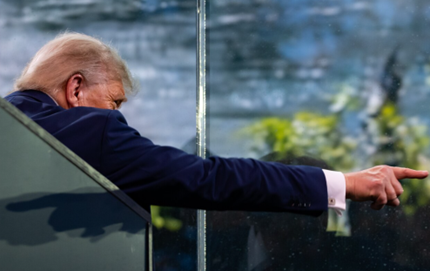
The headlines scream about oil and regime change in the Middle East. But behind the scenes, President Trump is about to unleash something far more shocking in the homeland.
You won’t hear about it on Fox Business or CNBC.
But it’s about to have a seismic impact on the wealth of every American patriot.
It’s the boldest initiative of President Trump’s second term by far – and it’s not even close. To find out why, and how it could affect your financial future – click here immediately.
🏦 Private Credit: The Other Contagion While oil grabbed the early headlines, liquidity tightened further.
BlackRock limited withdrawals from its $26 billion HPS Corporate Lending Fund after receiving $1.2 billion in redemption requests — roughly 9% of the fund.
Only 5% could exit. BlackRock shares declined 6.7%. Year-to-date, shares are down 25%.
Blackstone’s BCRED vehicle faced record redemption requests. More than 25 senior executives injected $400 million of personal capital to meet withdrawals. Blue Owl halted redemptions outright.
Morningstar’s Greggory Warren called it a warning sign about illiquid products sold to retail investors.
These private credit funds are structured as semi-liquid vehicles. Investors trade daily access for higher yield. That trade-off feels manageable until redemptions accelerate.
Our own Andrew Packer has been keenly focused on private credit for the past 18 months as an inflection point for the economy and stock market.
With a rising number of cracks in the private credit market forming, he’s making a move to protect from financial stocks melting down in the months ahead in the Grey Swan Trading Fraternity.
When trust collapses in the financial sector, moves tend to be faster than the meltup we’re seeing in oil prices.
“Credit events are like infectious diseases,” writes Dan Denning from Bonner Private Research: They are bad enough for those that have them. But when they jump from one carrier to the next, from private markets to public markets, that’s when you get bigger problems.
If the liquidity disease moves from private credit to publicly listed asset managers…and then to banks…and then to insurance companies…well then valuations suddenly matter a lot…and mean reversion (a stock market crash) becomes a real risk in 2026.
But I’m sure it’s ‘contained.’ That’s what Ben Bernanke told us about subprime mortgages in 2007. And it’s not like panic is contagious in financial markets, is it?
🌍 Escalation, the Calendar and Costs Iran’s leadership shifted after the death of Ayatollah Ali Khamenei. His son Mojtaba Khamenei has been pushed as his successor amid sustained U.S. and Israeli airstrikes.
A classified National Intelligence Council assessment, according to the Washington Post, concluded that regime collapse remains unlikely even under sustained assault.
A third U.S. carrier strike group may deploy to the region.
Meanwhile, Norway police are investigating an explosion near the U.S. embassy in Oslo. Saudi Arabia intercepted ballistic missiles headed toward Prince Sultan Air Base. The refinery exchanges between Tehran and Haifa signal a new phase — energy infrastructure as a target.
The Pentagon already estimates the war costs roughly $1 billion per day.
That’s what happened with our money over the weekend.
No drumroll. 🗓️ This Weekend in History — Bread, War, and Abdication (March 8, 1917) On March 8, 1917 — February 23 on Russia’s Julian calendar — women in Petrograd marched for bread.
Food shortages had been building for months. War with Germany had hollowed out transport, industry, and morale. Imperial Russia was bleeding men at a rate unmatched in previous wars. Inflation ran ahead of wages. Rail lines that should have delivered grain delivered soldiers instead.
Ninety thousand workers went on strike that day. Police tried to disperse them. The crowds stayed. By March 10, factories across Petrograd shut down. Workers elected deputies to a revived Petrograd Soviet, following the model of 1905. Police stations burned. Order frayed.
Nicholas II responded the way he often had — he dissolved the Duma.
On March 11, troops were ordered into the streets. Some regiments fired. Protesters fell. The crowds did not disperse. Within 48 hours, regiment after regiment of the Petrograd garrison defected. Roughly 150,000 soldiers shifted their allegiance and formed committees of their own.
On March 14, the Petrograd Soviet issued Order No. 1 — instructing soldiers to obey officers only if commands did not conflict with Soviet directives. The chain of command bent in half.
On March 15, Nicholas II abdicated. His brother Michael declined the throne. Three centuries of Romanov rule ended in a week.
The provisional government that followed hoped to restore order, continue the war, and fix the food crisis simultaneously. It faced empty railcars, exhausted soldiers, and a public that no longer trusted the center. Vladimir Lenin, then in exile in Switzerland, boarded a sealed train and crossed German lines to return home.
The immediate spark was bread. The structural strain was war finance, inflation, transport failure, and a leadership class that mistook decree for control.
Empires rarely fall on a Tuesday afternoon because of a speech. They erode when logistics falter, credit thins, and troops hesitate.
Bread shortages, insurance withdrawals, funding gaps — different century, different geography.
At least, we aren’t there… yet, right?
~ Addison
P.S. Thank you to everyone who joined Grey Swan Live! last week for our conversation with John Robb.
John Robb, author of Brave New War and Grey Swan Investment Fraternity contributor, joins us for a discussion on the war with Iran, how it’s being fought, and what it means for the dollar and other assets.  With market volatility on the rise and a new set of global challenges arising from this conflict, you won’t want to miss out on this week’s Grey Swan Live!
P.P.S. It seems like an odd week to be traveling. The Department of Homeland Security has yet to be funded by Congress. Lines a backing up at TSA checkpoints. And yet, this week, Grey Swan Live! will be recorded on the scene in Panama City — and sent out to members once it's ready — likely not at its usual time. Stay tuned for an email alert.
We’re traveling to join The Gathering, a group of investors in an international real estate project led by Ronan McMahon and his team at Real Estate Trend Alert.
Along with Alfredo Alemán we’ll be examining Panama’s 20-year outlook in a world where chokepoints and liquidity matter more than headlines.
The Ipanema and Beachwalk briefings will provide us with context on jurisdiction, infrastructure, and the long-term prospects for allocating some of our capital to vacation rentals across Latin America and in select places in Europe.
We’re looking forward to it. The Gathering was a unique experience in Playa del Carmen, Mexico last year. We expect nothing less of Panama City this year.
How did we get here? Find out in these riveting reads: Demise of the Dollar, Financial Reckoning Day, and Empire of Debt — all three books are now available in their third post-pandemic editions. You might enjoy one or all three.

(Or… simply pre-order Empire of Debt: We Came, We Saw, We Borrowed, now available at Amazon and Barnes & Noble or if you prefer one of these sites: Bookshop.org, Books-A-Million or Target.)
Please send your comments, reactions, opprobrium, vitriol and praise to: feedback@greyswanfraternity.com |


Post a Comment
Post a Comment