$969 billion in AI spending. Nowhere to plug it in. 
Conagra Stock Yields Nearly 9% After a 60% Decline—Time to Buy? Written by Thomas Hughes on April 2, 2026 
Key Points - Conagra is on track to return to growth and may effect the turnaround as early as the subsequent fiscal quarter.
- Cash flow is solid and signals safety for capital returns, including the high-yielding dividend.
- Institutions are scooping up this stock as it trades at deep-value levels.
- Special Report: Ticker Revealed: Pre-IPO Access to "Next Elon Musk" Company
 Down more than 60% from its highs, Conagra (NYSE: CAG) stock certainly presents risks. The forces that undercut market sentiment may persist, and stock prices may continue their decline. However, signals such as stabilizing business, cash flow, and the wicked-hot value suggest now is a good time to buy. While fiscal Q3 2026 results were mixed and guidance weak, the initial market reaction was less than bearish, with an early drop followed by accelerated buying that confirmed support at a critical price target. The target is the recent lows near $15. This is a long-term low, dating back to 2009, placing the business at deep-value levels relative to earnings. The company isn’t growing in 2026, but it is generating sufficient cash flow to cover its capital returns, and that is a market focus this year. Signs of technical support include the price candle with a long lower wick, elevated trading volume, and bullish crossovers in the stochastic and MACD. They indicate a Strong Buy, given the other factors, and may lead to a price rebound in Q3. Conagra presents value in more ways than one. At face value, the 9X price multiple is well below the consumer staples average and its own long-term trends. The 10-year historical average for this stock is closer to 18X, with highs in the 40X range, suggesting a triple-digit upside potential over time, as it enters earnings recovery. Additionally, with share prices so low, the dividend is in high-yield territory, yielding nearly 9% as of early April. Investors shouldn’t expect a dividend increase soon, but one is in the cards, and will be a catalyst for higher share prices as it emerges. As it stands, buybacks pose a risk, as they may slow until the transition to growth, expected in fiscal 2027. 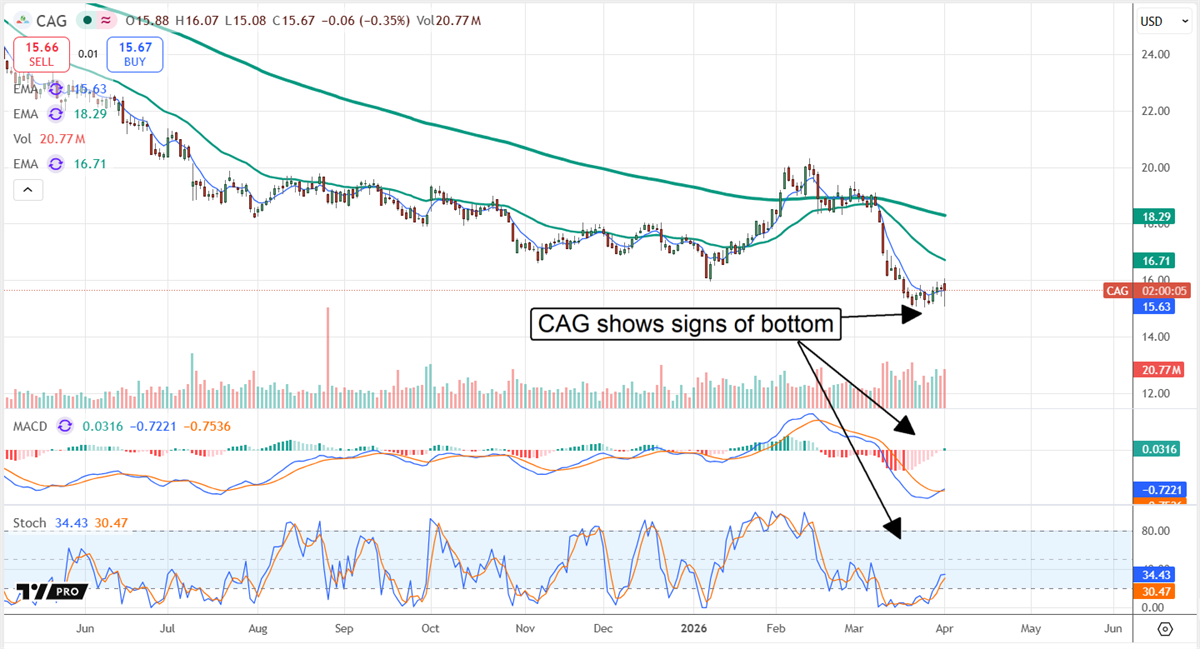
Analysts responded with caution but viewed the results favorably. While headwinds persist, strength in core categories and free cash flow were seen as signs of financial health, good news for the capital return. No price target revisions were logged immediately after the release, leaving the bearish trend in place, but the sentiment may change in upcoming quarters. Analysts noted management's high inflation expectations, setting the stage for cautious guidance and outperformance in upcoming quarters. Institutional activity is consistent with a market bottom and a stock price rebound. This group owns more than 80% of the stock and has been aggressively accumulating for the last year. Selling is also solid, but lags buying by half on a trailing 12-month basis and in Q1. The likely outcome is that they continue to accumulate, potentially accelerating their activity as the year progresses and subsequent earnings reports are released. After nearly five decades on Wall Street, Louis Navellier says a major currency shift is already underway - and the wealthiest Americans, including Musk, Zuckerberg, and Ellison, are quietly moving money out of dollars and into a different type of asset entirely. It's not bitcoin or any other crypto. Navellier has identified 7 companies he believes are positioned at the center of this trend - the last time he spotted a setup like this, Nvidia climbed as high as 10,000%. Watch Navellier's urgent briefing and get all 7 company names The AI bottleneck has shifted from chips to power. Goldman Sachs projects demand growing 15% per year, with 40% of AI facilities constrained by electricity shortages by 2027. One company holds $1.5 billion in backlog orders for the exact equipment these data centers need - yet Wall Street still prices it like a sleepy industrial stock. The June SpaceX IPO could change that fast. See the math Wall Street is missing before the SpaceX IPO Organic Strength Underpins the CAG Stock Price Bottom Conagra had a solid quarter despite headwinds and the impact of divestiture. The company reported $2.79 billion in quarterly revenue, down 1.9% from last year. Divestitures accounted for 480 basis points (bps) of the weakness, offset by 240 bps of organic growth. Organic growth was driven by a 1.9% increase in price/mix and a 0.5% increase in volume. Segmentally, the weakness was centered in Grocery. It fell more than 6%, with Refrigerated up 1.6%, International up 1.3%, and Foodservice up 1.8%. Guidance was a sticking point. Management narrowed its revenue and lowered its earnings-per-share targets, but otherwise issued a favorable outlook. The company expects business to be flat in Q4 and produce sufficient earnings to continue executing its strategy. Conagra returns to growth in the subsequent quarter, and its capital return remains safe. The free cash flow outlook is the rosiest of all, expecting a conversion rate above 100%. The biggest risk for Conagra is the shift to private labels. Private labels offer value compared to Conagra’s brands, but they lack the brand recognition. Names like Birdseye, Banquet, and Duncan Hines resonate with quality often lacking in the cheaper versions. Catalysts include AI, which the company is using to unlock savings and efficiency throughout the CAG operating environment. Read this article online › Read More 
Did you like this article?  
| 

Post a Comment
Post a Comment